Retargeting Strategy: A Step-by-Step Guide
Learn how to build a retargeting strategy step by step: set goals, segment audiences, choose ad formats, launch campaigns, and measure results.
15 Sep 2026
Retargeting allows advertisers and media buyers to reach users again after they have visited a website, viewed a product, or interacted with a brand. These users may have opened an offer, started a sign-up process, or browsed products without completing the intended action.
A structured retargeting plan turns those earlier interactions into an organized campaign. Advertisers determine who should be reached again, what the ads should communicate, how often they should appear, and how performance should be measured. The process begins with clear objectives and then moves through audience segmentation, campaign setup, tracking, testing, and ongoing optimization.
In practice, this means treating retargeting as a sequence of operational stages: build and exclude audience segments, define creative rotation and frequency, set budgets and bids, validate tracking, run controlled tests, and establish clear conditions for scaling.
What Is a Retargeting Strategy?
A retargeting strategy is a structured approach to reaching users who have already interacted with a website, ad, product, or brand but may not have converted. Instead of using the same approach for every user, the strategy groups audiences according to their behavior and relevance to the campaign. Key elements include:
- Audience selection;
- Campaign goals;
- Targeting parameters;
- Ad formats and creatives;
- Budget;
- Conversion tracking;
- Ongoing optimization.
These elements shape how users move through the campaign after their initial interaction.
Why Retargeting Is Important for Advertisers
Many users do not convert during their first visit. Some compare alternatives and postpone a decision. Others leave during registration, while some need more information before taking action.
Retargeting allows advertisers to reach these users again instead of relying only on new traffic. It creates additional opportunities to engage people who are already familiar with the brand or offer.
This can also improve the value of traffic that has already been acquired. However, retargeting works best when the message remains relevant to the audience and the campaign is measured accurately.
Step 1: Set Retargeting Goals
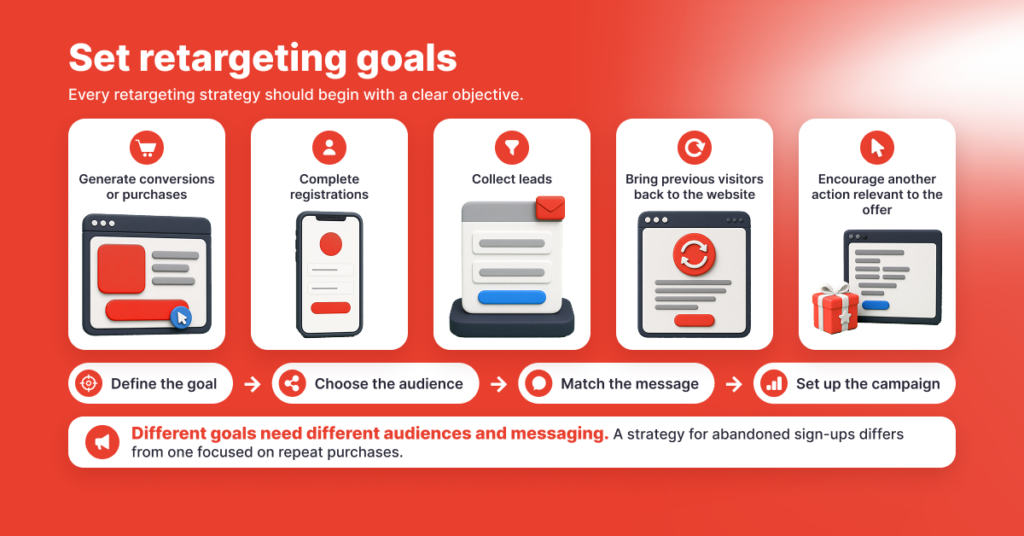
Every retargeting strategy should begin with a clear objective. Common goals include:
- Generating conversions or purchases;
- Completing registrations;
- Collecting leads;
- Bringing previous visitors back to the website;
- Encouraging another action relevant to the offer.
The objective shapes the rest of the campaign. A strategy designed to complete abandoned sign-ups requires different audiences and messaging from one focused on repeat purchases.
Step 2: Choose the Retargeting Audience
The next step is deciding which users should enter the retargeting audience. This group can include website visitors, users who viewed specific pages, people who started an action but did not complete it, or existing customers.
The audience should be based on actual user behavior rather than assumptions. A visitor who viewed one page briefly may show less intent than someone who reached the final stage of registration.
Website Visitors
Website visitors who leave without converting form a broad retargeting audience. Advertisers can segment them according to the pages they visited, the content they viewed, or their level of engagement.
For example, someone who only viewed the homepage can be separated from a visitor who opened a specific product or offer page. This helps keep subsequent messaging more closely aligned with the user’s previous interaction.
Users Who Did Not Convert
Users who begin an intended action and then leave can represent a higher-intent audience. Common examples include users who started registration, opened a lead form, or progressed through part of a checkout process.
Because they took additional steps before leaving, they may show stronger interest than users who completed only a basic visit. Retargeting creatives can therefore focus on returning them to the unfinished step rather than repeating the entire offer.
Existing Customers and Users
Retargeting can also be used for existing customers or registered users when the campaign objective is appropriate. Possible goals include repeat purchases, return visits, or renewed engagement with a product or service.
This differs from standard acquisition retargeting. Existing customers already have a relationship with the brand, so the messaging and campaign objectives should reflect that context.
Step 3: Segment the Retargeting Audience
Using one audience for every previous visitor can reduce relevance. Audiences can be segmented by:
- User behavior;
- Funnel stage;
- Pages or products viewed;
- Previous actions;
- Engagement level.
A user who viewed an offer may need a different message from someone who almost completed registration. Segmentation also allows advertisers to compare performance between groups instead of relying on one overall campaign average.
In Kadam, retargeting segments can be built from Pixel and Campaign audiences — for example, a Campaign audience that collects conversions, or a Pixel audience placed on the conversion page. Campaigns can then include the audiences advertisers want to reach and exclude segments that should no longer receive the same message — for example, users who have already completed the target conversion.
Step 4: Choose the Right Retargeting Ad Formats
Retargeting campaigns can use Banner, Native, Push, In-Page Push, Popunder, and Video. Display formats provide visual exposure. Native ads appear alongside publisher content. Push ads deliver short, direct messages. Popunder can direct users to a dedicated landing page.
The most suitable format depends on the audience, campaign objective, funnel stage, and advertising environment. No single format performs best for every retargeting campaign.
Step 5: Set Targeting Parameters
Retargeting audiences can be combined with additional targeting controls. Depending on the platform, available settings may include GEO, device type, operating system, browser, language, placement, and frequency.
More precise targeting can improve relevance. For example, mobile and desktop users may need to be separated if their landing pages or conversion paths differ. However, too many restrictions can reduce audience size. Targeting should support the campaign objective rather than limit traffic without a clear reason.
Step 6: Create Retargeting Creatives
Retargeting creatives are designed for users who have already interacted with the brand. The ad should be recognizable and connected to the user’s previous interaction. Branding should remain consistent, while the offer and call to action should reflect the next step the campaign is intended to encourage.
Where the chosen format supports multiple materials within a campaign, advertisers can use several creatives and assess them separately rather than relying on a single message throughout the campaign.
Returning visitors do not always need the same message as first-time users. Repeating a general introductory message can reduce the value of the earlier interaction.
Personalize Retargeting Messages
Personalization can begin with audience relevance rather than individual messaging. If a user viewed a product page, the ad can refer to that product. If the user starts registration, the message can encourage completion. If a visitor viewed an offer but took no further action, the next message may provide additional context. The purpose is to maintain continuity between the first interaction and the retargeting ad.
Avoid Ad Fatigue
Showing the same creative too frequently can reduce performance. Creative rotation can provide variation, while frequency caps limit how often a user sees the same ad (more on this in Step 8). Regular testing can also help identify when engagement begins to decline.
Step 7: Create Relevant Landing Pages
Retargeting ads and landing pages should form one consistent user journey. If an ad refers to a specific offer, the user should arrive on a page that continues the same message. Sending users to a generic homepage can create unnecessary additional steps.
Landing pages should match the ad, the offer, and the user’s previous interaction. Calls to action should remain clear, pages should load quickly, and the mobile experience should minimize friction.
Step 8: Set Retargeting Frequency
Frequency controls how many times an ad is shown to the same user. If exposure is too low, the message may have limited impact. If it is too high, ad fatigue can increase and spending may become less efficient. Frequency caps help manage this balance. The appropriate level depends on the buying cycle, campaign duration, funnel stage, and offer type. In Kadam, frequency caps can be set at the campaign level, and at the material level for formats that use creatives. Campaign-level caps limit overall retargeting pressure, while material-level caps help manage exposure to an individual creative. Popunder campaigns use a campaign-level cap only.
Step 9: Set Up Tracking and Measurement
Conversion tracking should be configured before the retargeting campaign begins. Advertisers need to define which actions count as conversions. Common examples include sign-ups, purchases, form submissions, app installs, or other completed target actions. Intermediate events can also be tracked. These may include visits to key pages or progress through a registration flow.
Step 10: Launch the Retargeting Campaign
Before launch, the campaign should be reviewed as a complete system. Pre-launch checklist includes:
- Confirming the retargeting audience;
- Reviewing targeting and frequency settings;
- Checking creatives and CTAs;
- Testing landing pages;
- Verifying conversion tracking;
- Confirming the budget and bids;
- Reviewing campaign and platform restrictions.
Identifying an error before traffic begins is generally easier than correcting the problem after campaign data has already been affected.
At this stage, advertisers can also set daily and total campaign budget limits, use even budget distribution, and apply advanced bids to individual traffic slices. In Kadam, an automated bidding rule based on extended statistics can calculate the bid as eCPC multiplied by a coefficient from 0.1 to 2.0; a maximum bid must always be specified so that automatic adjustments remain within the advertiser’s limit.
Step 11: Measure Retargeting Campaign Performance
Key metrics can include impressions, clicks, CTR, conversions, conversion rate, CPA, and CPM. Where relevant, ROI or ROAS can also be monitored. A campaign may appear stable at an overall level while one audience generates most conversions at a significantly different CPA. Segment-level reporting makes these differences easier to identify.
Step 12: Test and Optimize the Retargeting Strategy
Retargeting performance improves through ongoing testing and analysis. Advertisers can test:
- Audience segments;
- Creatives and messages;
- Targeting parameters;
- Frequency settings;
- Landing pages;
- Budget allocation.
Retargeting Strategy for iGaming Brands
Retargeting can be useful for iGaming brands because users may go through several stages before completing the intended action. Audiences may include users who visited a casino or sportsbook website, viewed a promotion, started registration, or interacted with the brand without completing the next step. Segmentation can reflect these actions, while creatives should correspond to the funnel stage the user previously reached.
Regulatory requirements are particularly important in this sector. Rules vary by GEO, and advertisers may need appropriate licenses or authorization. Responsible advertising requirements can include restrictions on targeting minors and obligations relating to responsible-gaming information.
Advertising platforms may impose additional requirements involving certification, GEO eligibility, creatives, or landing pages. For example, Google permits regulated gambling-related ads only in selected countries and where the relevant certification conditions are met. Advertisers are also expected to comply with applicable local laws. Campaign setup therefore needs to account for both marketing objectives and platform or GEO-specific requirements.
How Advertisers Use Kadam for Retargeting
Kadam provides Pixel and Campaign audiences for retargeting, allowing advertisers to reach users again at different stages of the funnel. Its advertiser platform also supports campaign targeting and frequency controls.
Available formats include Popunder, Push, In-Page Push, Banner, Native, and Video. This gives advertisers several options for testing how retargeting audiences respond across different advertising environments. Kadam also provides targeting parameters such as GEO, device type, operating system, browser, and language, along with the frequency, budget, and bidding controls described in the steps above.
For iGaming campaigns, the same toolset can be used to segment returning users and test different creatives or formats, provided that the campaign complies with the offer requirements and the rules that apply to the selected GEO. Kadam also provides campaign management and reporting tools, allowing teams to monitor performance and optimize campaigns over time.
Common Retargeting Strategy Mistakes
Even a well-structured retargeting campaign can lose effectiveness when basic principles are overlooked. Using one audience for every visitor often leads to generic messaging. Overly broad targeting can make it difficult to identify which segments are performing well. Excessive frequency can also cause ad fatigue.
Other common problems include using the same creative across all segments, launching without reliable tracking, directing users to landing pages that do not match their intent, and making optimization decisions before enough data has been collected.
Retargeting Strategy Best Practices
A great retargeting approach usually includes several core principles:
- Define a clear campaign objective;
- Segment audiences according to real behavior;
- Match creatives to user intent;
- Use relevant targeting parameters;
- Control ad frequency;
- Track conversions accurately;
- Test different approaches;
- Update decisions using current performance data.
Each element matters, but consistency between them is particularly important. The audience, message, landing page, and measurement approach should all support the same campaign objective. Operationally, this also means deciding in advance which segments enter or leave the campaign, when a creative should be stopped, how much budget can be spent, what data makes a test valid, and which measurable conditions justify scaling.
Conclusion
An effective retargeting strategy begins with a clear objective and an audience built from actual user behavior. Advertisers can then select targeting parameters, ad formats, creatives, landing pages, and frequency controls that match the campaign. Tracking shows what happened, while testing helps identify which combinations perform best for individual audience segments.
Retargeting is therefore not a single fixed setting. It is an ongoing process of re-engaging users, analyzing their response, and refining the campaign as new performance data becomes available.
FAQ
Which Ad Formats Work for Retargeting?
Display, Native, Push, Popunder, and other supported formats can be used for retargeting. The most suitable choice depends on the campaign objective, audience segment, funnel stage, offer, and advertising environment.
How Do Advertisers Create a Retargeting Strategy?
The process begins with the campaign objective and the identification of users who have already interacted with the brand. Advertisers can then segment the audience, choose suitable ad formats and targeting controls, prepare relevant creatives and landing pages, configure tracking, launch the campaign, measure performance, and optimize the strategy using campaign data.
What Is the Best Audience for Retargeting?
The most appropriate group depends on the objective. Retargeting typically focuses on users who have already visited a website or interacted with a product, offer, or brand. Users who progressed further through the funnel may indicate stronger intent, while broader visitor groups can still be useful for other retargeting objectives.





Read Also
More Precise Adult Targeting: 40+ Subcategories in Kadam

How to Choose High-Quality Paid Traffic for Your Advertising Campaigns
Retargeting Campaigns: How They Improve Conversion Rates
Popunder Ads Examples: Campaign Flows and Landing Pages
DarkSword Reached Ad Traffic: Why a Normal Landing Page Can Hide an iOS Attack
Direct Advertiser vs Ad Network Which Model Is Better
Managing CPC Campaigns with Auto Rules
VAST Creatives Are Now Available in Kadam Video Campaigns
What Is Retargeting Advertising and How Does It Work