Funnel-Based Retargeting: How to Segment Your Audience Effectively
Learn how to set up retargeting across the sales funnel. We break down 6 audience segments, remarketing logic, frequency capping, performance metrics, and real examples from Kadam.
13 Jul 2026
Most visitors do not become customers after their first visit. According to various estimates, around 98% of website visitors leave without converting, and that is completely normal. People rarely make a decision immediately.
The real problem is different: you have already paid for every one of those visitors. For a click, an impression, or a visit from an ad. If the user does not come back, that investment stops working.
That is why properly configured retargeting is one of the most effective ways to increase conversions without spending more on attracting a new audience.
Retargeting solves exactly this problem: it brings back users who have already interacted with your product but have not taken the next step. They visited the website and closed the tab. Registered and disappeared. Added funds to their account but never launched a campaign.
The most common mistake is putting all website visitors into one audience and showing them the same ads.
This is why audience segmentation is the foundation of effective retargeting: each segment sees personalized advertising that matches its current stage in the sales funnel. This is the approach we use at Kadam.
The solution is simple: divide users who left by funnel stage and work with each segment separately. Below, we show how this works using our own example. In our case, we ended up with six retargeting segments.
This number is not universal. Some businesses may need four segments, others may need ten. What matters is not the number, but the principle.
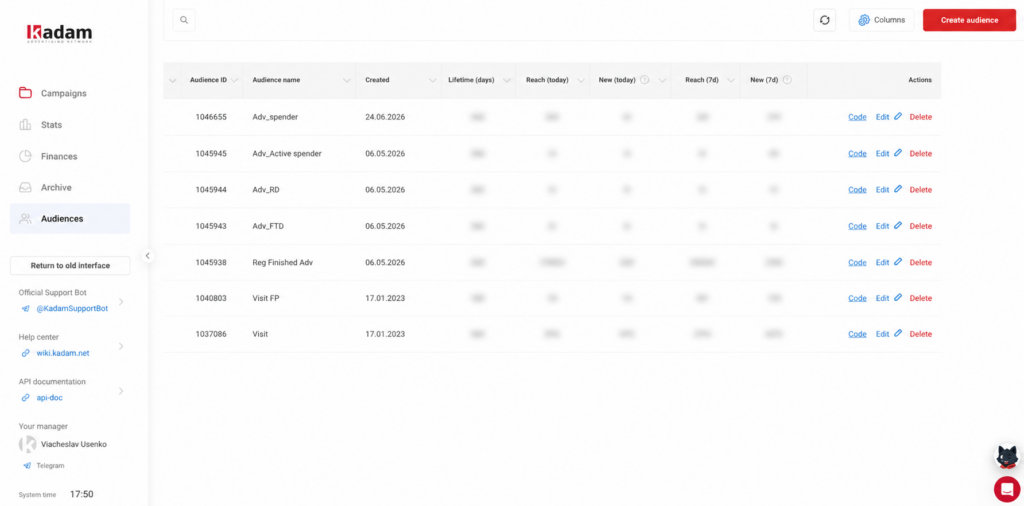
1. Visited the Website but Did Not Register
They came, looked around, and left. They did not register, leave their contact details, or make a purchase.
This is the largest audience and, at the same time, the coldest one. These users already know about your product, but their interest was not strong enough to make the next step.
At this stage, it is too early to talk about discounts or special offers. First, you need to remind them about your product and bring their interest back.
The effectiveness of this approach is supported by research. According to Invesp, users who see retargeting ads are 70% more likely to convert on a website, and 26% of users return to a website specifically through a retargeting ad.
The mechanism is simple: the person already knows the product, which is why they click on this type of ad much more often than on a regular display ad — 0.7% compared to 0.07%, on average.
These audiences often show some of the highest conversion rates because users have already shown interest in the product and are only one step away from the target action.
2. Registered but Did Not Make the First Deposit
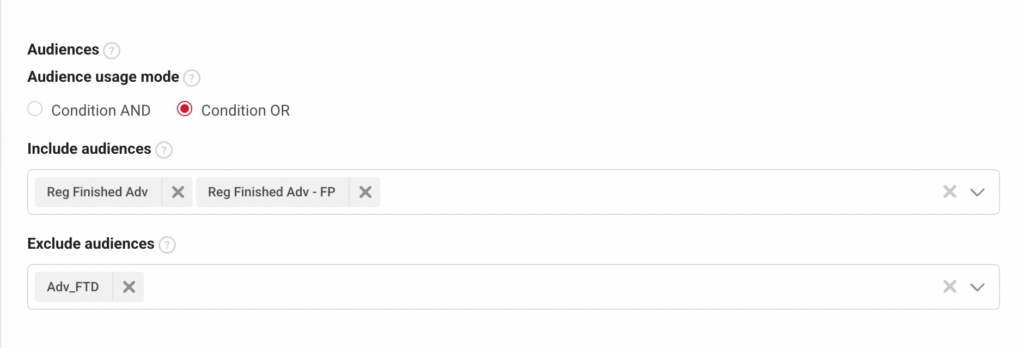
These users have already taken the first step but stopped there.
The reasons may vary: they did not have enough time, had questions, or felt that setup would take too much effort.
At this stage, there is no point in introducing the brand all over again. The user has already registered, so the goal of advertising is to remove doubts and help them take the next step.
How this works for Kadam partners: in iGaming, this segment is often called non-FD. The user has registered but has not made the first deposit. Our partners bring such users back with retargeting and get the first deposit at a cost of up to $1.5 in Brazil, up to $10 in Kazakhstan, and up to $15 in Portugal.
3. Added Funds but Did Not Start Using the Product
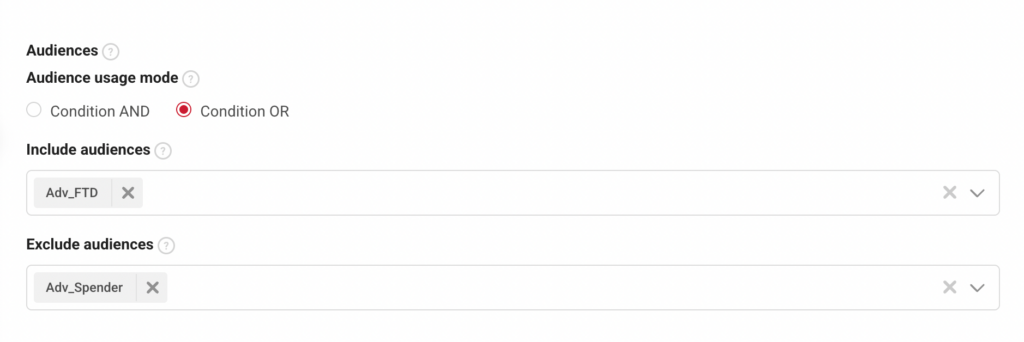
This segment is often overlooked.
In our case, these are advertisers who added funds to their balance but never launched their first campaign. Some return after a few days. Some never come back at all.
These users do not need to be sold the product again. They need help getting their first result: show them that launch does not take much time, explain the next steps, or offer support from a specialist.
4. Made the First Purchase but Did Not Return
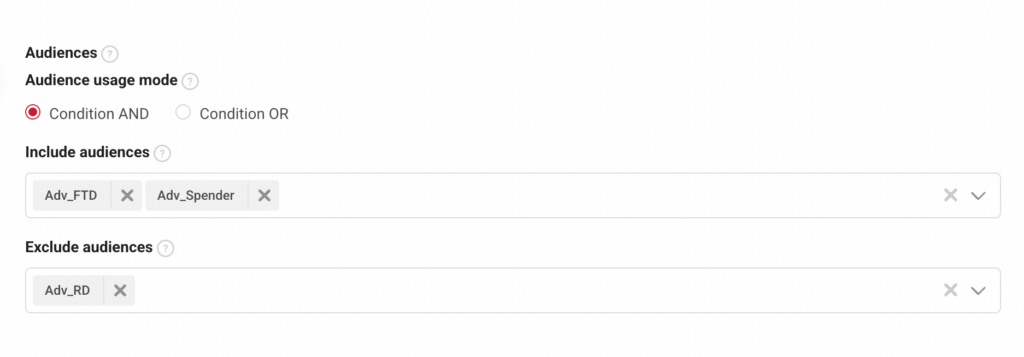
These are customers who have already worked in the account and added funds, but only once.
It is important not to mix them with those who already purchase regularly. We are interested specifically in users who stopped after their first successful experience and are now somewhere between the first and second purchase.
This segment is built using the AND operator. The user must belong to two audiences at the same time: FTD, meaning they made the first deposit, and Spender, meaning they spent money in the account. One condition is not enough. FTD without spending is a person who added funds and then froze — we covered that in the third segment. Here, we need a customer with real product experience.
At the same time, this user is not included in the RD audience, meaning repeat deposits: they never came back for the second payment. This gives us a precise profile: they tried the product, spent money, but did not order more.
How this works for Kadam partners: in iGaming, this segment is called 2dep. The user made the first deposit but did not return for the second one. With retargeting, the cost of the second deposit is:
• Brazil — up to $1
• Kazakhstan — up to $3
• Portugal — up to $12
And notice the pattern if you compare this with the non-FD numbers above: in all three GEOs, the second deposit is cheaper than the first one. The deeper the user is in the funnel, the cheaper it is to bring them back.
5. Stopped Using the Product
Here, it is important to separate users who have actually stopped using the product from those who are still active.
To do this, it is not enough to collect all customers into one audience. You need to exclude the audience that continues to use the service regularly.
The first condition selects users with real product experience. The second condition, through AND, filters out current customers who simply do not need a “come back” message.
Seven days is not a universal threshold. Each product should define its own inactivity period: for some, a pause starts after a week; for others, after a month. Use your purchase cycle as a reference.
The earlier you notice the pause, the higher the chance of bringing the user back, and the cheaper reactivation becomes. A user who has not logged in for a week still remembers the product. The earlier user reactivation starts, the higher the chance of success and the lower the cost of customer retention. Someone who disappeared three months ago will need to be convinced almost like a new user.
At this stage, messages with a fresh reason to return usually work better: a new feature launch, additional capabilities, new formats, or special offers.
Results from Kadam partners: in iGaming, this segment is called non-active. Reactivation, meaning a repeat deposit after a period of silence, costs partners up to $1 in Brazil, up to $1.5 in Kazakhstan, and up to $2.5 in Portugal. This is much cheaper than acquiring a new user. At the same time, a reactivated user brings 2–3 times more revenue than a new FTD: they already know the product, and the trust has already been built.
6. Active Customers
These are users who already work with you regularly.
Using AND, we include those who have added funds more than once and whose campaigns have been active in the last seven days. The condition that excluded users in the previous segment includes them here. As a result, the segments do not overlap: an inactive customer goes into reactivation, while an active one goes into this segment.
Showing this audience an ad that asks them to “come back” makes no sense. Instead, you can tell them about new product features, offer additional tools, or introduce them to updates.
For an active audience, the advertising campaign should focus not on bringing users back, but on customer retention, increasing LTV, and encouraging repeat purchases.
Results from Kadam partners: in iGaming, this audience is called active base. Here, each repeat deposit made within the attribution window after an ad view or click is counted as a conversion. Such deposits cost partners up to $0.05 in Kazakhstan, up to $0.1 in Brazil, and up to $0.5 in Portugal. These are the cheapest conversions across the entire funnel: the ad does not need to convince anyone, it simply reminds the user at the right moment.
How to Choose Frequency Capping for Retargeting
Segmenting the audience is not enough. It is also important to choose the right moment to show the ad.
If you start too early, the user may not be ready to return. If you start too late, their interest may already be gone.
Frequency capping is just as important. The same banner shown dozens of times is more likely to irritate than help.
That is why each segment should have its own logic: some users only need a few reminders after a visit, while others should see ads only after a period of inactivity.
Good Retargeting Is Built Not Only on Inclusions, but Also on Exclusions
In many advertising systems, you can create an audience based on the principle “everyone who completed a certain action.” But that is not enough.
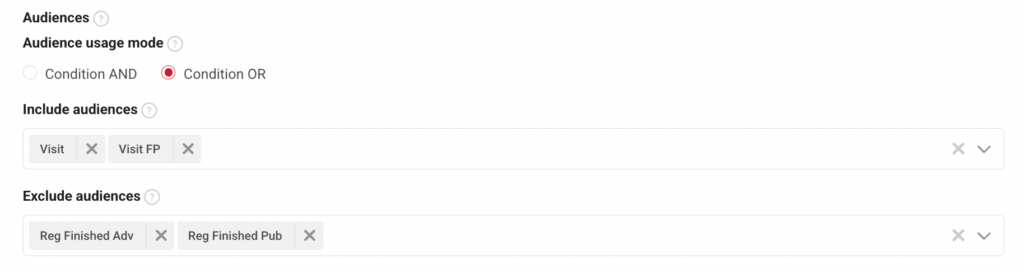
Results usually become noticeably better when you start combining conditions and excluding irrelevant audiences.
For example:
Show ads to users who added funds and launched campaigns at least once, but exclude those who continue to add funds regularly.
Show ads to users who were active before, but exclude those who worked in the system during the last seven days.
Each additional condition makes the audience more precise. Each exclusion removes users who simply do not need this ad right now.
As a result, you only pay for impressions that can actually move the user to the next step.
How to Measure Retargeting Performance
Do not look only at CTR.
A high click-through rate does not necessarily mean that retargeting is bringing business results. What happens after the click is much more important.
Evaluate whether more users are moving to the next stage of the funnel. Whether the cost of registration, first purchase, or another target conversion is going down. Whether repeat purchases are increasing. Whether the time between the first visit and conversion is getting shorter.
Post-view and post-click attribution help you see these conversions. A user may see a banner, remember the product, and return on their own — through search, bookmarks, or a direct visit. In a last-click model, this conversion would be lost.
That is why it is worth using two attribution models:
• Post-click (PC) — counts conversions after a click.
• Post-view (PV) — counts conversions after an ad view, even if there was no click.
The attribution window should be chosen based on the length of the sales cycle.
A classic post-view window is 24 hours: Google also counts view-through conversions by default within a 1-day window, while click-through conversions are counted within a 30-day window. Google does not recommend click-through windows shorter than 7 days because they usually do not collect enough data.
Only this approach allows you to see the real contribution of retargeting to conversions instead of evaluating campaigns only by clicks.
There is one more detail that is often overlooked. Retargeting relies on cookies, and cookies do not live forever: the user may update the browser, switch to another browser, or visit from another device, and the connection is lost. Kadam automatically works not only with cookie-based audiences, but also with fingerprint audiences built on cookie data. Even if the cookie expires, the system can recognize the user and continue reaching them with ads.
This Logic Works for Almost Any Business
We have shown segmentation using Kadam as an example, but the logic itself is universal.
Any company has website visitors, users who did not complete registration, first-time customers, repeat purchases, lost customers, and active customers.
For example, in SaaS, someone may have viewed the pricing page but never submitted a request. Someone may have registered for a trial but never started using the service. Someone may have been a customer but did not renew the subscription.
An agency has a similar story. One person downloaded a case study but never contacted a manager. Another ordered a project and never came back. A third client has not reached out with new tasks for a long time.
Conference organizers also have their own stages. Someone viewed the program but did not buy a ticket. Someone attended last year but has not registered this year. Someone has already bought a ticket, and they can be offered a booth or sponsorship package.
In all cases, the principle remains the same: people are at different stages of the journey, so communication with them should be different too.
Build the Audiences That Exist in Your Business
Almost every business already has users who can be brought back with retargeting: website visitors, incomplete registrations, first-time buyers, loyal customers, and users who stopped using the product long ago.
The main task is not to combine them into one audience, but to build retargeting by sales funnel stage. This approach helps reduce the cost of conversion, increase repeat purchases, and use the advertising budget more efficiently.
If you want to understand which audience segments are worth creating for your product, Kadam specialists can help analyze your funnel, identify where users drop off, and set up retargeting based on the specifics of your business.



Read Also
New Guide by Kadam: How to Get More FTDs from the Traffic You’ve Already Paid For
Push vs Popunder vs Native Ads: Which Format to Choose
Kadam Introduces KAI: Your Personal AI Assistant Inside the Ad Platform
How to Build a Retargeting Funnel for iGaming Campaigns
Buy Popunder Traffic: How to Choose Quality Sources
How to Choose a Popunder Ad Network

AI Creatives in iGaming: What Really Impacts CTR and Conversions (Data + Cases)
What Are Pop Ads?
Building a User Journey: Touchpoints, Frequency, and Creative Sequencing