Push vs Popunder vs Native Ads: Which Format to Choose
Compare push, popunder, and native ads to choose the right format for performance campaigns, affiliate marketing, traffic acquisition, and campaign optimisation.
23 Jun 2026
For advertisers, media buyers and affiliate marketers, choosing an ad format is not just a matter of making it look good. It changes the traffic cost, how much people want to buy, the creative workload, the structure of the landing page, how quickly it can be made to work better, and later on, how much it will cost to win customers.
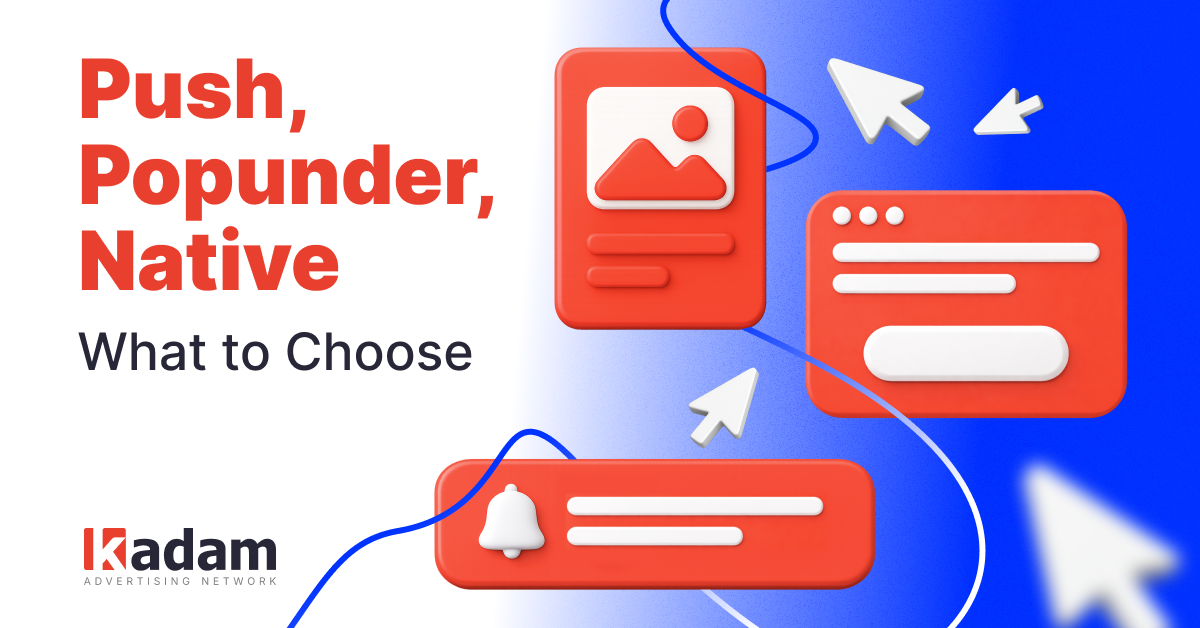
Push vs popunder vs native ads becomes a recurring question in performance marketing. These formats all send people into a funnel, but they do it through different routes. Push ads run on short notifications like messages. Popunder ads drop users to a landing page via another browser tab, or even a separate window. Native ads feel closer to the surrounding content, and they usually need a more muted, almost editorial approach.
There is no single champion. The better fit depends on the offer, GEO, budget, vertical, funnel length, and how much testing the advertiser can actually maintain.
Why Ad Format Choice Matters in Performance Marketing
In performance marketing, the format shapes everything in the campaign. It affects how people notice the ad, how much attention they give it, and what sort of landing page they expect right after the click.
Also, the format can shape cost. Some online advertising formats seem to deliver cheaper traffic but with colder intent. Other options can end up costing more, yet they send users who are more ready to act or who show better engagement even before the click.
Creative requirements are different as well. For push, you usually need a short title, some image or an icon, plus a clear CTA. Popunder leans hard on the landing page, because the user typically arrives cold. Native ads, meanwhile, ask for stronger headlines and visuals, and often they use a content-style pre-lander, before the main page.
And then there is optimisation. With push, advertisers usually test messages and icons. With popunder, they compare sources, landing pages, and frequency. With native, the testing tends to include angles, headlines, creative variations, and how the content flows.
What Are Push Ads?
Push ads are promotional notifications that show up to users through a device or browser environment. They typically come with a short title, a quick message, an icon or image, and a call to action.
The format is straightforward. It performs best when the offer can be explained quickly, and the audience understands it fast. A push message gives very little room for tutoring, so the core value has to be obvious from the first line.
For instance, push can be a good fit for alerting, time bounded offers, app promotions, sweepstakes, dating, financial topics, and reactivation campaigns. It also helps when advertisers need to reach people rapidly with a single action.
The biggest benefit is speed. Campaigns can be launched and tested in a short cycle. The main restriction is space. If the offer needs a longer explanation, push may need a robust landing page or a pre-lander that completes the message.
What Are Popunder Ads?
Popunder ads open an advertiser’s landing page in a new browser tab or window, behind the currently active page, which is kind of the reason the user won’t notice right away. The user first lingers on the original website and may only see the ad page after they switch tabs or maybe close the current one.
In this kind of setup, the main creative is usually the landing page itself, or a pre-landing step before it. The user usually didn’t click through after reading a detailed message, so the page itself needs to explain the offer fast.
Popunder is commonly used in traffic acquisition when advertisers need volume, quick evaluations, and wide coverage. You’ll often see it in affiliate campaigns across iGaming, dating, utilities, apps, sweepstakes, and adult verticals.
The format can feel efficient, but it is cold traffic. A landing page that is slow, confusing, or loaded with too much content can waste the visit before the user even realizes what is being offered.
What Are Native Ads?
Native ads are ad placements made to look more like the surrounding content on a website or app, which can feel seamless to the person browsing. Usually you see them as recommended articles, sponsored posts, content cards, or in feed blocks, and they often blend in with what is already on screen.
Native is the more content driven format. It depends on a solid headline, a relevant image, a clear angle, and it often includes a pre landing page that warms the user up before the main offer actually appears.
Compared with standard display advertising, native can feel less intrusive because it fits the page environment better. But that does not automatically mean you will get better performance. If the headline is weak or the angle is misleading, performance can drop fast.
Native tends to work best when the offer needs explanation, credibility, or context. Finance, health, eCommerce, nutra, and long form funnels often choose native, because users need more information before they decide to convert.
Push vs Popunder vs Native Ads: Key Differences
The easiest way to compare push vs popunder vs native ads is to look at how each ad format meets the user, in practice.
| Criteria | Push ads | Popunder ads | Native ads |
| User intent | Medium, message-based | Low to medium, landing-page driven | Medium to high, content-driven |
| Creative needs | Title, message, icon/image, CTA | Fast landing page or pre-lander | Headline, image, angle, content flow |
| Cost structure | Often CPC or CPM | Often CPM or CPC | Usually CPC or CPM |
| Traffic volume | Medium to high | High | Medium |
| Launch speed | Fast | Very fast | Slower due to creatives/content |
| Optimisation focus | Messages, icons, segments | Sources, landing pages, GEO/device | Headlines, angles, pre-landers |
| Best use cases | Alerts, simple offers, re-engagement | Volume tests, affiliate offers, direct-response funnels | Education-heavy offers, warm-up funnels |
| Landing page role | Important | Critical | Often part of a longer funnel |
The table looks clean but real campaigns are not. A good media buyer may use two or even all three formats for the same offer, each in a different funnel step.
When to Choose Push Ads
Use push ads when the deal can be explained in a quick message and what the user needs to do is also easy. Push notifications are especially useful for urgent messages, such as limited-time offers, alerts, bonus reminders, app installs, and for bringing people back after they have left.
In affiliate campaigns, push often works well with sweepstakes, dating, finance, apps, utilities, and a few iGaming journeys. You can also use it for retargeting when the audience already knows the brand or the offer.
When to Choose Popunder Ads
Choose popunder ads when you want big traffic volume, quicker testing, and a straightforward conversion path. Popunder can be handy for affiliate tests, iGaming, dating, utilities, apps, sweepstakes, and adult campaigns.
This format works best when you have a fast landing page, a clear offer and proper tracking. Since people usually land with lower intent, the first screen matters a lot. The page should load quickly, lay out the value, and show a CTA that is easy to spot.
Popunder can also be helpful when advertisers want to test a few GEOs or offers without doing all that complex creative work. This doesn’t mean it is free money. Source optimisation, device split, and landing page testing are still essential. For affiliate marketing traffic, popunder can be a practical starting point when the campaign needs usable data quickly.
When to Choose Native Ads
Pick native ads when the offer needs some warming up first. Native often matches better with finance, health, eCommerce, nutra, insurance, investment-style offers, and other funnels where users need context before they convert.
This format supports storytelling. A native ad can bring the user to a pre-lander, an article, a comparison page, a review, or an educational piece before sending them to the final offer.
But just because something is native doesn’t automatically mean it’s better quality. It depends on how creative it is, where it is published, who the audience is, the landing page and whether the offer is suitable. If the headline or image doesn’t appeal to the user, they won’t click on it. Native usually needs more preparation than push or popunder.
Which Format Works Best for Different Verticals?
For iGaming, popunder, push, and native can all work depending on the funnel. Popunder can pull in volume, push can act as a reminder and support retargeting, and native can warm up users through editorial style content.
Dating often lands well with push and popunder, because the message can be straightforward and the path to conversion is usually simple.
Utilities and apps typically do well with popunder and push, especially when the landing page loads quickly and the next step is obvious.
Finance and eCommerce often need native or push. Native helps explain the value more clearly, while push can support reengagement, or help with shorter, timed offers.
Also, the format itself does not promise anything. The offer, GEO targeting, landing page, tracking setup, and optimisation steps decide what happens in the end.
Cost and Pricing Models: CPC, CPM, and CPA
Online ads can be sold via different pricing schemes: CPC, CPM, or CPA. CPC is paying for clicks. CPM is paying for impressions. CPA is paying for a defined action, like registration, app install, sale, or deposit.
None of these models is automatically better. A low CPC can still end up with pricey conversions if the traffic does not convert. A higher CPM may work well if the landing page and the offer are performing. An apparently safer CPA arrangement may come with tighter traffic requirements, plus less control.
The final efficiency depends on CR, CPA, ROI, and traffic quality, and it’s easy to miss that connection. Advertisers should avoid judging a format only by the price of a click or impression, because that can mislead what matters.
Landing Page and Creative Requirements
Push ads need a strong short creative, and not too much thinking on day one. The title and message should spark interest quickly. The landing page has to carry the same promise forward, without making the user feel puzzled.
Popunder ads need a fast, simple landing page. The user is cold, so the page must spell out the offer right away. Long blocks of text or slow loading can noticeably reduce performance.
Native ads need a strong headline, image, angle, and usually a pre-landing page. The creative should match the surrounding content style and gently prepare the user for the offer, before they fully engage.
How to Test Push, Popunder, and Native Ads
Start with one offer. Decide on the format that would work best for the funnel. Instead of putting them all in one report, share each campaign separately on push, popunder and native. A tracker and postback should be used to measure conversions.
A basic test plan:
- Choose one offer and target GEO;
- Prepare format-specific creatives or landing pages;
- Split budget by format;
- Track visits, clicks, conversions, CR, CPA, and ROI;
- Review performance by source, device, and GEO;
- Pause weak segments and scale stronger ones.
Collect clean data and identify which format fits the offer best.
Mistakes When Choosing an Ad Format
One common mistake is when people only look at the price. If cheap traffic doesn’t result in sales, it can end up costing you.
Another mistake is sending a quick offer to people who have never visited your website before, without doing anything in between. In other words, skipping the pre-lander entirely.
Weak headlines or unoriginal images are usually what spoil native campaigns. In push campaigns, on the other hand, ambiguous messages and an unintelligible CTA contribute to their failure.
Advertisers also often don’t realise how important it is to keep track of failures accurately. This is to make sure that the formats are segmented fairly in the analytics, so that the performance can be compared accurately. It is necessary to work out the results in the same way and clean the conversion data.
Test Push, Popunder, and Native Ads with Kadam
Kadam provides advertisers with the necessary traffic volume and tools to test different ad formats in a structured manner. With over 11 billion impressions processed daily, the platform enables media buyers to launch and compare push, popunder, native and other formats across multiple geographic regions without waiting for inventory.
Targeting options include geography, device, operating system, browser, language and placement, enabling each campaign to be tailored or scaled according to the offer, sector and budget. Advertisers can also use retargeting tools to re-engage users who have visited a page, interacted with a campaign or expressed interest, but did not convert the first time.
Traffic quality is verified before reaching the campaign budget. Kadam’s built-in anti-fraud system, Kaminari, helps to filter out suspicious, invalid and bot traffic. Meanwhile, performance data enables advertisers to compare sources, adjust bids, pause weak segments and scale up stronger ones.
Push, popunder and native are not the only formats available on the platform. Advertisers can also work with in-page push, banner and video ads, making Kadam useful for multi-format acquisition and retargeting strategies. Teams that require additional support beyond self-serve setup can receive help with campaign launch, creatives, analytics, and ongoing optimisation from Kadam.
However, Kadam should not be treated as a guaranteed ROI shortcut. Results still depend on the offer, funnel, creatives, landing page, targeting, budget and testing process. However, for advertisers who want to compare formats based on real data rather than assumptions, Kadam provides the necessary scale, targeting, anti-fraud protection and optimisation tools to properly run this process.
Conclusion
There is never a uniform format which can be clearly labeled as being the best solution out there for the purpose of push vs popunder vs native ads. Each of these has a different role to perform.
The best decision comes from knowing your objectives, offer, GEO, budget, and funnel and then testing with discipline. Advertisers won’t ask how well each format is working. They will ask which of these suits this offer, this audience, and the situation within their funnel.
FAQ
What is the difference between push, popunder, and native ads?
Push ads appear as notification-style messages. Popunder ads open a landing page in a separate tab or window. Native ads blend into the surrounding content, adopting an editorial style.
Which ad format is best for affiliate marketing?
There are no single best formats; it depends on the kind of offer, GEO, funnel, payout model, and also landing page. Push, popunder, and native can all be successful.
Are popunder ads cheaper than push and native ads?
Not necessarily. Popunder impressions are often cheaper than push or native, but a lower cost per impression doesn’t always mean a lower cost per conversion that depends on CPA, CR, ROI, and traffic quality.
When should advertisers use push ads?
Advertisers should use push ads when the offer can be explained quickly through a short message, clear CTA, and simple landing page.
Can Kadam help with different ad formats?
Yes. Kadam can support advertisers with different ad formats, targeting settings, statistics, and optimization tools for campaign testing and scaling.



Read Also
More Precise Adult Targeting: 40+ Subcategories in Kadam
DarkSword Reached Ad Traffic: Why a Normal Landing Page Can Hide an iOS Attack
Direct Advertiser vs Ad Network Which Model Is Better
Managing CPC Campaigns with Auto Rules
VAST Creatives Are Now Available in Kadam Video Campaigns
What Is Retargeting Advertising and How Does It Work
New Ways to Add HTML Creatives
Campaign Group Budgets: Limits at a Glance
Retargeting Ads Explained: When and How to Bring Lost Customers Back