AI Creatives in iGaming: What Really Impacts CTR and Conversions (Data + Cases)
We analyze which AI creatives in iGaming actually drive higher CTR and conversions. Research data, Kadam insights, and a breakdown of effective and weak creative approaches.
06 May 2026
AI has long become part of creative production: from idea generation to scaling variations. But together with this, advertisers started asking questions: does it reduce quality, lead to empty clicks, or lower CTR?
In iGaming, these risks are perceived especially sharply: here every key action is connected to a deposit, so without trust in creatives, users simply do not proceed to payment.
To understand how justified these concerns are, we analyzed one of the largest studies of AI creatives in performance advertising conducted under the leadership of Columbia University, based on the analysis of performance campaigns and A/B testing of creatives, and compared these findings with real campaign data from Kadam, including CTR and user behavioral patterns.
2. What the Research Showed
2.1 AI Creatives Can Perform as Well as Human-Made Ones
The research shows that AI creatives already demonstrate comparable, and in some cases even higher CTR compared to creatives created by humans.
2.2 CTR Grows Without Conversion Loss
CTR growth is not accompanied by a decline in conversion quality. AI creatives attract attention without reducing traffic value.
2.3 Perception Matters More Than Technology
Users may not distinguish whether a creative was made by AI or a human: ultimately, it is not the technology that matters, but perception — natural-looking visuals work, artificial-looking ones do not. This is exactly why “AI-looking” creatives often underperform, especially when they look too perfect, glossy, symmetrical, and overly smoothed.
2.4 The Main Driver Is Human Faces
One of the most consistent drivers of engagement growth is the use of human faces. They create a sense of reality, increase trust, and directly impact CTR.
3. AI Creatives in iGaming in Practice: Real Kadam Data
Before moving to specific creative approaches, it is important to understand that their effectiveness directly depends on the audience.
According to industry data:
- 54% of online betting and gaming revenue comes from users aged 25–44
- 61% of players use mobile devices exclusively
- 38% of new registrations come through bonus and promo messages
At the same time, player motivations differ:
1. entertainment-driven players:
• 78% play for entertainment
• 33% play for challenge
2. reward-oriented players:
• 65% play for winnings
• 28% engage because of bonuses and loyalty rewards
3. socially engaged players:
• 42% play for social interaction
This means a creative should not simply attract attention, but match a specific user motivation. Otherwise, CTR growth will not lead to deposit growth.
What Actually Works
According to our creative team, formats consistently perform well when users instantly understand what is being offered and why it is interesting.
Working Approaches
- Attention (faces, contrast)
- Motivation (bonus, FOMO)
- Action (CTA, gamification)
Top Creative Approaches
Analysis of top-performing creatives shows that high CTR is not accidental — it is built on repeating mechanics and visual patterns. Below are the key approaches most often found in the top performance range.
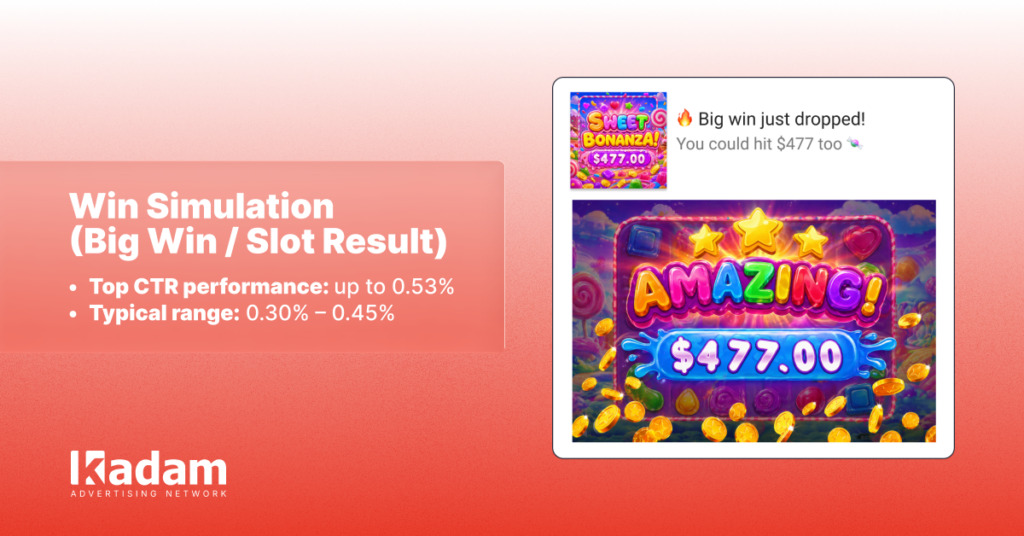
Win Simulation (Big Win / Slot Result)
Creatives imitating a winning screen from a real popular slot consistently show some of the strongest CTR results and regularly appear among top-performing iGaming solutions.
Core Idea
Instead of promising a bonus, the creative shows an already received win, as if the user had just won it themselves. Due to its visual similarity to the game interface, it is perceived not as advertising, but as part of the gaming experience.
Why It Works
This format triggers several effects simultaneously:
- recognition trigger (“I know this slot”)
- increased trust through realism
- reduced banner blindness
- stronger desire to repeat the result
Where It Performs Best
This approach works especially well:
- with broad audiences due to slot popularity
- together with a landing page featuring the same slot
- in retargeting campaigns, reinforcing the “come back and convert” effect
CTR
- Top performance: up to 0.53%
- Typical range: 0.30% – 0.45%
Streamer / Social Proof
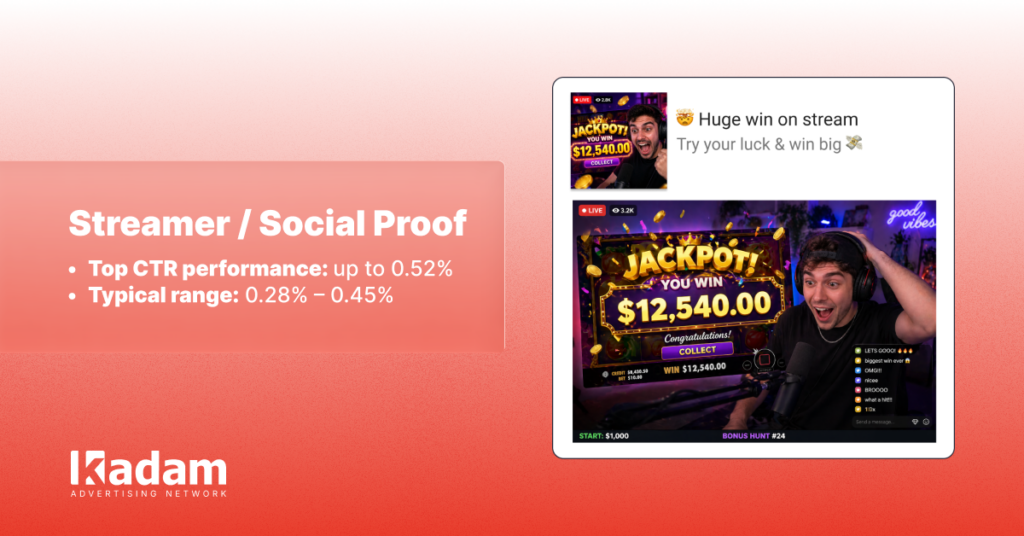
Creatives featuring streamer reactions and win demonstrations work as a native content format.
Users perceive such visuals not as banners, but as part of the media feed: a clip, a reaction, or a stream fragment. This lowers resistance and increases engagement.
The emotional reaction additionally strengthens the effect, making the creative feel more “alive.”
Why It Works
The main strength of this approach lies in social proof:
- if someone already won, the result feels achievable
- emotional reactions increase engagement
- the “content, not advertising” format lowers resistance
- it creates the feeling of a real experience rather than a promo
Where It Performs Best
This approach works especially well:
- with cold audiences thanks to its native format
- in social and push-like environments where content competes for attention
- in creatives focused on fast engagement
CTR
According to the analysis of top-performing creatives:
- Top performance: up to 0.52%
- Typical range: 0.28% – 0.45%
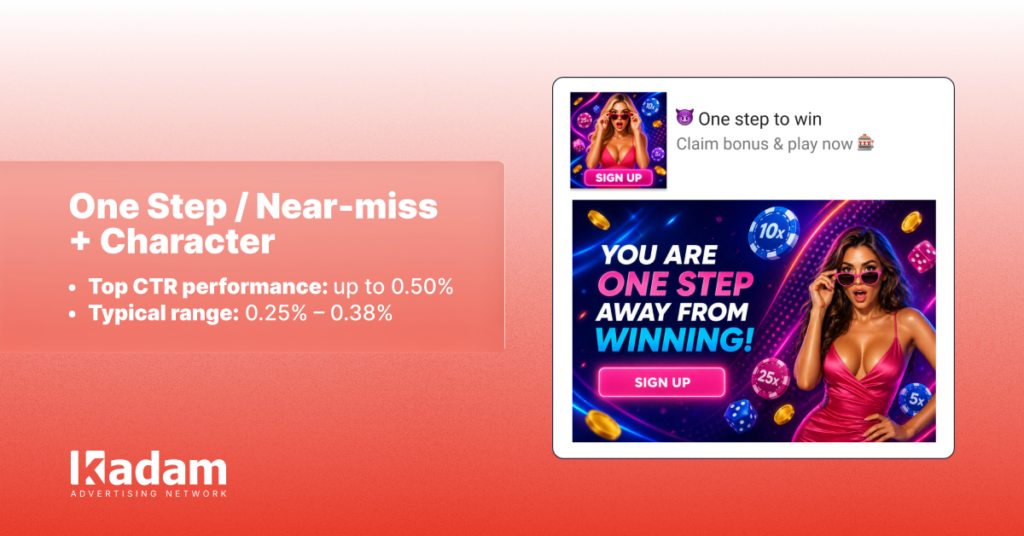
One Step / Near-Miss + Character
This approach is built around the “almost won” effect and strengthened by a character.
Instead of a direct offer, the user receives an emotional trigger: the feeling that they are already close to the result. This reduces the need for analysis and turns the action into an impulse.
Why It Works
This approach relies on several strong behavioral mechanisms:
- near-miss effect (“almost got it”)
- FOMO (fear of missing out)
- dopamine trigger from anticipating the result
Additionally, using a face increases engagement and attracts attention, positively affecting CTR.
Where It Performs Best
This approach works especially well:
- in retargeting, where users already know the product
- in creatives designed for fast response
- in scenarios where emotional engagement needs to be strengthened
CTR
According to the analysis of top-performing creatives:
- Top performance: up to 0.50%
- Typical range: 0.25% – 0.38%
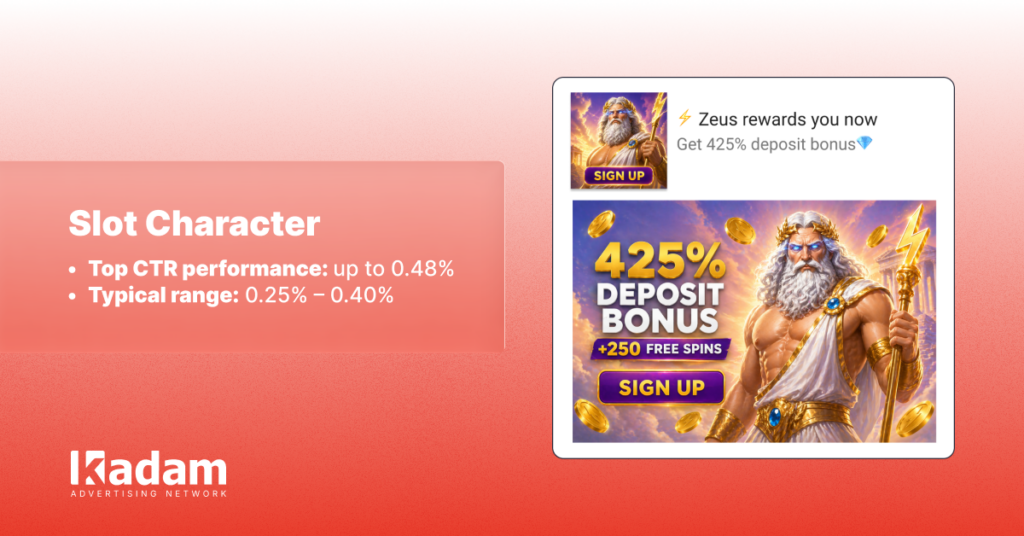
Slot Character (Recognizable Slot)
Creatives built around characters from specific slots (for example, Zeus) create a direct connection with the product.
Core Idea
The visual completely replicates the style and atmosphere of a specific game, making the creative feel not like a separate advertising element, but like an extension of the gaming experience.
Why It Works
This format strengthens several key factors at once:
- recognition trigger (“I know this game”)
- increased trust through familiar visuals
- reduced gap between the creative and the landing page
- higher conversion due to strong relevance
Where It Performs Best
This approach works especially well:
- with audiences familiar with specific slots
- together with landing pages featuring the same product
- in campaigns where precise relevance and expectation matching matter
CTR
According to the analysis of top-performing creatives:
Top performance: up to 0.48%
Typical range: 0.25% – 0.40%
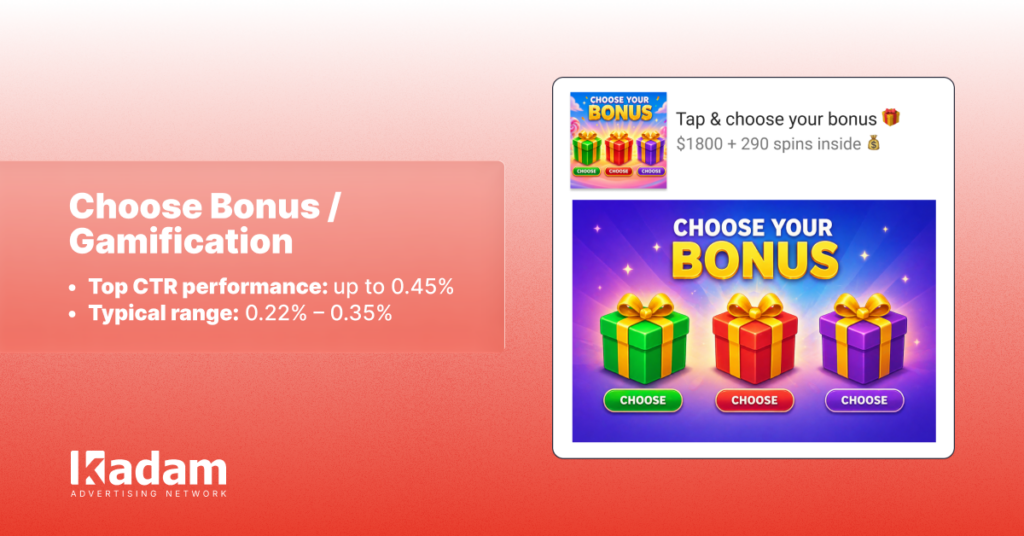
Choose Bonus / Gamification
Instead of simply displaying an offer, the creative encourages action: choose a bonus, open a gift, or make a decision.
Users do not just see the offer — they begin interacting with it. This creates a sense of control and lowers the entry barrier.
Why It Works
This approach shifts users from passive viewing to active participation:
- creates a sense of control
- lowers the entry barrier
- increases engagement before the click
- keeps attention longer through the choice mechanic
In practice, the creative simulates a mini-game before the transition, increasing the likelihood of a click.
Where It Performs Best
This approach works especially well:
- in campaigns targeting cold audiences
- in formats where interaction can be visually simulated (banners, in-page)
- in offers with bonus selection or variable rewards
CTR
According to the analysis of top-performing creatives:
Top performance: up to 0.45%
Typical range: 0.22% – 0.35%
Timer + Wheel (FOMO + Chance)
The combination of a timer and a wheel strengthens the effects of urgency and randomness.
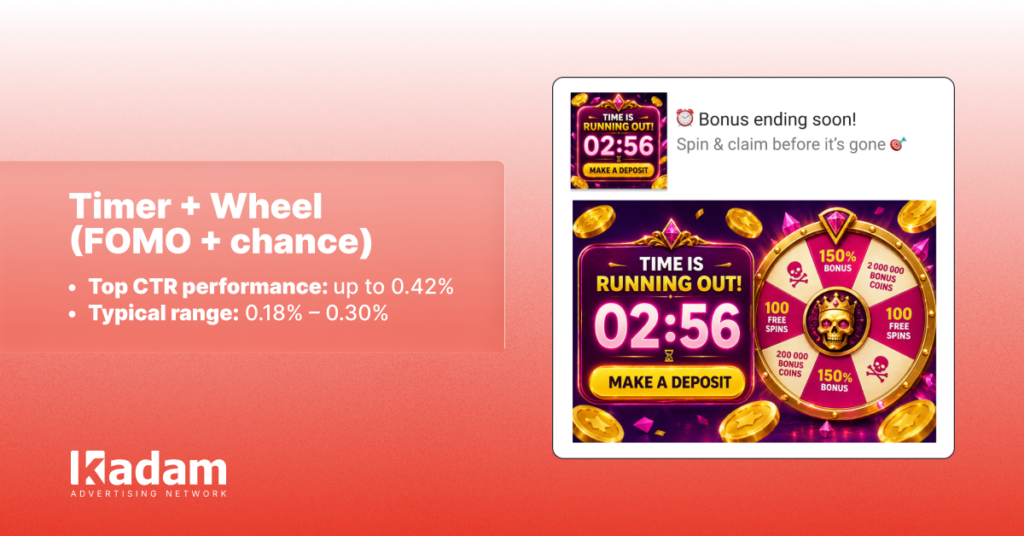
Users simultaneously receive:
- a time limitation
- a chance to get more
This reduces procrastination and speeds up decision-making. The creative works on impulse rather than rational choice.
CTR
- Top performance: up to 0.42%
- Typical range: 0.18% – 0.30%
General Conclusion
Despite differences in mechanics, all highly effective creatives share one logic: they do not simply show an offer — they create an experience.
In all cases, the user becomes engaged before the click, not after it.
This, rather than visual complexity or “beauty,” most often determines CTR growth.
*Campaign results may also depend not only on creative approaches, but also on GEO and targeting settings.
3.2 Anti-Patterns: What Lowers CTR in iGaming Creatives
Most CTR drops are caused not by a lack of ideas, but by breaking the basic logic of perception.
Weak creatives usually fail not because they are “ugly.” More often, the issue is different: users cannot quickly understand the value, do not know where to look, or instantly recognize the banner as template advertising. Below are the main patterns most commonly associated with low CTR.
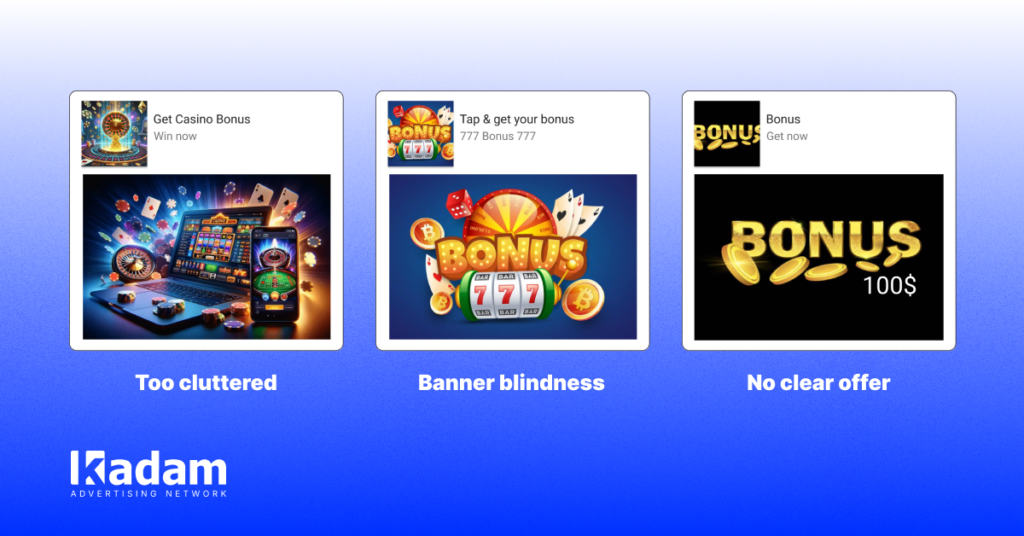
1. Too cluttered
Too many elements in one creative: character, bonus, coins, buttons, slot, background, text, extra labels. As a result, the eye cannot focus on anything specific.
In iGaming, this is an especially common mistake: the desire to show “everything at once,” while users only see visual noise. The more competing objects there are, the harder it becomes to quickly understand what is happening and where to click.
Typical CTR: 0.08% – 0.15%
Why it underperforms: the brain cannot process the message quickly enough.
2. Banner Blindness
These are creatives that feel like “just another generic betting ad”: standard background, generic visual elements, predictable bonus messaging, standard CTA button. Users have already seen these patterns dozens of times and tend to ignore them automatically.
The issue is not the vertical itself, but the lack of a distinctive visual pattern. When creatives don’t resemble real content, gameplay, notifications, or specific user scenarios, they quickly fall into the ignore zone.
Typical CTR: 0.06% – 0.14%
Why it underperforms: looks like template advertising.
3. No clear Offer
If there is no specific bonus, amount, value proposition, or clear CTA in the creative, it loses commercial meaning. Users may notice the image, but they do not get an answer to the question: “why should I click?”
In performance creatives, specificity is especially important. Numbers, bonuses, free spins, deposit offers, or other value should be immediately understandable.
Typical CTR: 0.06% – 0.14%
Why it underperforms: no numbers = no value.
Examples
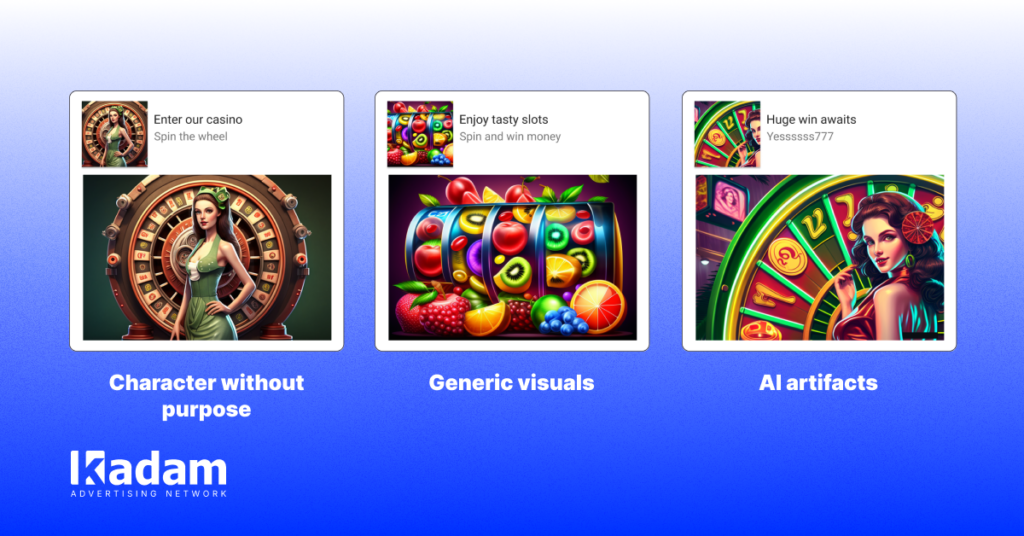
4. Character Without Purpose
A face or character can improve CTR, but only if it serves a purpose: conveying emotion, creating trust, reinforcing the offer, or directing attention.
If the character simply “stands on the banner,” it becomes decorative. In this case, the face does not improve engagement and can even distract from the offer.
Typical CTR: 0.10% – 0.18%
Why it underperforms: the face exists, but it does not strengthen the message.
5. Generic Visuals
777, roulette, cards, random chips, stock “bonus” graphics — all of this has long become visual noise. These elements no longer provide new value or create interest on their own.
They can only work if integrated into a strong mechanic: a recognizable slot, a specific win, bonus selection, streamer reaction, or FOMO. Without this, they are perceived as outdated banner advertising.
Typical CTR: 0.06% – 0.14%
Why it underperforms: users have already seen it hundreds of times.
6. AI artifacts
An AI creative may look bright and “almost correct,” but on closer inspection it reveals itself: strange hands, distorted faces, unnecessary details, blurry text, unnatural anatomy, and visual mistakes.
Such creatives are especially dangerous in iGaming, where trust directly impacts conversion. Users may not consciously analyze details, but the feeling that “something is wrong” lowers their willingness to click.
Typical CTR: 0.08% – 0.15%
Why it underperforms: the visual looks artificial and reduces trust.
Examples
General Conclusion
Weak creatives most often fail not because of a single mistake, but because of a combination of factors: visual noise, lack of clear value, template execution, and weak connection to action.
A good iGaming creative should not simply look bright. It should quickly answer three questions:
- what is being offered
- why it is interesting
- what users should do next
*Campaign results depend not only on creative approaches, but also on GEO and targeting settings.
4. What Is Especially Important for iGaming
4.1 Trust
In iGaming, users move toward a specific action — making a deposit. Therefore, the trust threshold for creatives is much higher here than in most other verticals. Fake or overloaded visuals destroy this trust, and users simply never reach the deposit stage.
4.2 Creative Is Part of the Funnel
The creative sets expectations, and if the landing page does not fulfill them, users leave. People may click out of curiosity, but they will only register and deposit if everything forms one coherent picture.
4.3 Scale
In iGaming, success comes not from one perfect creative, but from a testing system.
The more variations and the faster the iterations, the higher the probability of finding a working combination.
4.4 AI + Retargeting
AI works well at the cold traffic acquisition stage, allowing teams to quickly test creative hypotheses.
Retargeting, in turn, recovers missed conversions.
4.5 Compliance With Regulations
Another key aspect directly affecting creative performance is compliance with local laws and market requirements.
AI does not account for regulatory specifics across different countries. It may generate:
- ad copy violating UK regulations
- visuals prohibited in Germany
- wording creating false expectations of winnings
In iGaming, this is especially critical: such mistakes are expensive, from rejected campaigns to bans and traffic loss.
How Kadam Works With Content in a Regulated Environment
To avoid these risks, creative work is built as a process rather than one-time generation.
Step 1. Fast Generation With AI
We use AI to create hypotheses, copy, and visuals to accelerate production and testing.
Step 2. Compliance Verification
All materials are checked against an internal checklist that considers the requirements of different GEOs.
Step 3. Market Adaptation
Creatives are adapted for specific countries: wording, visual elements, and offers are adjusted according to local restrictions.
Step 4. Production and Launch
After verification and adaptation, creatives are scaled and used in campaigns.
Conclusion
AI has already become a tool in performance advertising. However, the final result is still determined not by the technology itself, but by how the creative process is structured.
Kadam allows advertisers to manage campaigns at every stage: from creative development and testing to scaling and optimization.
The team handles the full cycle: analysis, hypothesis creation, testing, selection of effective approaches, and further campaign development. This approach helps find winning combinations faster and consistently improve performance.





Read Also
More Precise Adult Targeting: 40+ Subcategories in Kadam
DarkSword Reached Ad Traffic: Why a Normal Landing Page Can Hide an iOS Attack
Direct Advertiser vs Ad Network Which Model Is Better
Managing CPC Campaigns with Auto Rules
VAST Creatives Are Now Available in Kadam Video Campaigns
What Is Retargeting Advertising and How Does It Work
New Ways to Add HTML Creatives
Campaign Group Budgets: Limits at a Glance

Retargeting Ads Explained: When and How to Bring Lost Customers Back