
Retargeting for Mobile Users: How to Re-Engage High-Intent Audiences
Learn how to re-engage high-intent mobile audiences with retargeting. Explore audience collection, targeting strategies, and Push, In-Page Push, Popunder, Native, Banner, and Video ads.
15 Oct 2026
Many mobile users do not complete the desired action immediately. They may open an offer, explore it, and then leave. Another user may register but stop before making a first-time deposit. A previous customer may also become inactive for several weeks. These groups are not the same, even if all of them use smartphones.
Effective mobile retargeting starts with one key principle: advertisers need to understand where each user is in the funnel. They can then collect the available audience signals, divide users into separate segments, and re-engage them with ads suited to their situation.
Mobile is not a standalone retargeting product. It is the combination of targeting, ad creative, and a landing page designed around the way users interact with offers on smartphones.
What Is a High-Intent Audience in Retargeting?
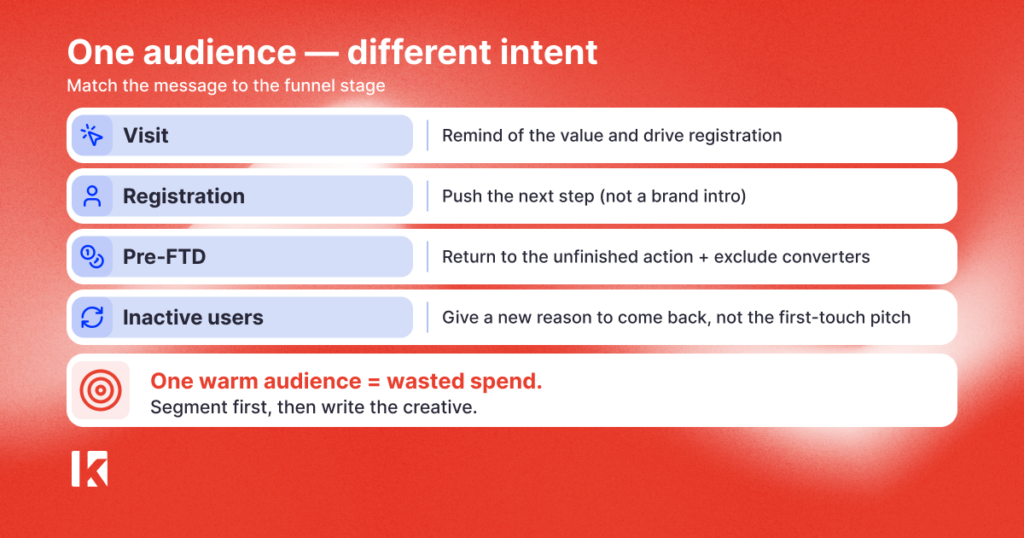
High intent is defined by funnel stage rather than device type. A visitor has demonstrated interest by opening an offer. Someone who has completed registration has progressed further. A registered user who has not yet made a first-time deposit is at a different stage, while a user who previously converted but later became inactive requires another re-engagement strategy.
A basic funnel may look like this: Visit → Registration → FTD → Active User → Inactive User
Each stage provides different information about intent.
| Funnel Stage | Known User Action | Retargeting Objective |
| Visit | Opened the website or offer | Encourage a return and registration |
| Registration | Created an account | Move the user towards the next relevant action |
| Pre-FTD | Registered but has not completed FTD | Return the user to the offer |
| Converted | Completed the target action | Support further engagement where appropriate |
| Inactive | Previously engaged but later stopped | Reintroduce the relevant offer or product |
This distinction matters because retargeting tends to work best when the message reflects what the user has already done. A broad acquisition ad can still reach these users, but it ignores useful context already available to the advertiser.
From Website Visit to Registration
At the upper end of the warm-audience funnel are users who opened the website or offer but did not register. They are not entirely cold because they are already more familiar with the product than someone who has never encountered it. However, relatively little may still be known about their next intended action.
The usual objective is to bring them back to a relevant page and give them another opportunity to continue. Audience rules can separate these users from people who have already registered. This prevents registration-focused messaging from continuing to reach users who have already completed that step.
The ad creative should also relate to what the user saw previously. If someone viewed a specific offer, sending that person to an unrelated homepage creates an additional and unnecessary step.
From Registration to First-Time Deposit
Users who registered but did not complete a first-time deposit are further down the funnel. They have already shown stronger intent, so the retargeting message should not simply repeat a basic brand introduction.
Instead, the campaign should focus on the next relevant step in the user journey. Claims should remain accurate and should not rely on exaggerated messaging or unsupported promises. Retargeting is effective because users are already familiar with the product, not because advertisers can apply greater pressure.
Strict exclusion rules are also important for this segment. Once a user completes the target action, an ad designed solely to encourage FTD should normally stop being shown.
Re-Engaging Inactive Users
Inactive users represent another warm-audience segment. This group includes people who previously used the product or completed a conversion but have not triggered a relevant event for a defined period.
What qualifies as inactivity depends on the business. One advertiser may use a period of several days, while another may require a longer window. The timeframe should be defined first, after which the segment can be created.
Inactive users should not be placed in the same group as recent visitors or pre-FTD users. Their previous history changes which message is likely to be relevant.
How to Build a High-Intent Mobile Audience
Before retargeting begins, advertisers need to collect the signals that define each audience. This stage comes before selecting Push, Popunder, Native, or any other ad format. The process generally consists of three steps:
- identifying the events that correspond to funnel stages;
- capturing those events through the available tracking methods;
- creating inclusion and exclusion rules for each segment.
For example, a visitor audience may include users who opened a landing page while excluding anyone for whom a registration event has already been recorded. A pre-FTD audience may include users with registration events while excluding them once an FTD event is recorded.
All tracking and audience-building activity should also comply with applicable privacy, consent, and data-processing requirements.
Pixel-Based Audience Collection
Pixel tracking can record actions on a website. A pixel can register a page view or another configured event, and that information can then be used for audience creation.
This approach can support common retargeting scenarios. A landing-page view may identify users who entered the funnel, while other tracked events can divide visitors according to the actions they take afterward.
Pixel events typically feed cookie-based audiences. Fingerprint matching can extend reach when cookies are limited or unavailable.
The audiences that can be created depend on the technical setup and the events being captured. Pixel collection should therefore follow the funnel strategy rather than being implemented without a clear purpose. If visits need to be distinguished from registrations, the tracking setup must be able to identify those states separately.
Server-to-Server (S2S) Tracking
Server-to-server tracking transfers events directly between backend systems. This can be useful when important funnel events, such as registration or conversion, are recorded reliably on the advertiser’s side.
For example, a page visit may be recorded through browser-based tracking, while a registration or FTD can be confirmed using backend data.
S2S can therefore provide another layer when building and updating retargeting audiences. It should not, however, be treated as automatic confirmation that every event will be available.
The retargeting system can only process the information that the integration is configured to transmit. Results also depend on how accurately the integration is implemented and maintained.
Fingerprint-Based Identification
Fingerprint-based methods can help associate technical signals when common identifiers are unavailable. They can provide additional options for linking activity to an audience.
However, fingerprinting should not be presented as guaranteed identification. Browser behavior can change, device characteristics can vary, and privacy settings may limit the information that is available.
Applicable legal and privacy requirements must also be considered. Fingerprinting is therefore best treated as one possible matching method within a wider retargeting strategy rather than a universal replacement for other audience-collection methods.
How to Segment High-Intent Audiences for Retargeting
Once usable events are available, segmentation becomes the next priority. An account structure can include separate audience groups such as:
- visitors who did not register;
- registered users who have not completed FTD;
- users who have already converted;
- users who have become inactive.
These groups should not be combined by default. A visitor with no registration history has less context than someone who has already created an account. The ad creative, landing page, and campaign objective should reflect that distinction.
Exclusions are as important as inclusion rules. If a campaign is intended to move users from registration to FTD, those users should normally stop being targeted once the conversion is recorded, unless the advertiser has a separate and valid reason to continue reaching them.
More precise segmentation reduces wasted impressions and keeps the message aligned with the user’s actual stage in the funnel.
Retargeting Ad Formats for Mobile Audiences
Ad format selection becomes relevant only after the audience has been collected and segmented.
Kadam supports several formats that advertisers can use for retargeting, including Push, In-Page Push, Popunder, Native, Banner, and Video.
None of these should automatically be described as a mobile retargeting product. In practice, mobile campaigns depend on appropriate targeting settings combined with mobile-friendly creatives and landing pages.
Push Ads for Audience Re-Engagement
Push ads can deliver a concise message that encourages users to return to a relevant offer or page. These ads tend to work best when they communicate one clear message and use a visible call to action. Because the format offers limited space, including too many benefits at once can make the message harder to understand.
Segmentation is particularly useful. A visitor who never registered should not receive the same message as a registered user who stopped before completing the next funnel stage. Classic push also depends on notification availability and user subscription settings. Reach should therefore not be treated as universal.
Popunder Ads for Mobile Retargeting
Popunder ads can provide another way to bring users back to an offer. For retargeting, the audience should be defined before the format is selected. The objective is not to assume that every mobile visitor can be matched individually. Instead, advertisers should use the targeting options and available audience data to focus on relevant groups.
Frequency requires particular attention. If a user has already seen the offer many times, opening another page will not necessarily increase interest. Browser compatibility and landing-page behavior should also be checked on smartphones before spend is increased.
Native Ads for Relevant Offers
Native ads can deliver a retargeting message in a format that fits naturally within the surrounding ad environment. This format often provides more space than a short push message, allowing additional context to be communicated.
For warm audiences, this can be useful when the offer requires further explanation. The ad and landing page should remain aligned. If the creative highlights one benefit but the landing page focuses on something different, the value of retargeting is reduced.
Banner Ads for Mobile Retargeting
Banner campaigns can also be used to re-engage warm audiences. The primary limitation on mobile is screen space.
Text must remain readable; the creative should communicate its message quickly, and the call to action should remain visible rather than disappearing within a design originally created for desktop. On smaller screens, simpler creatives are generally easier to understand. The user may already be familiar with the offer, so the ad does not need to repeat every detail.
Video Ads to Re-Engage Users
Video can be useful when additional space is needed to present the offer or regain the attention of an audience that has already interacted with it. In mobile video, the opening seconds are particularly important.
Users may leave quickly, so the main message should not appear only at the end of a long introduction. Vertical and other mobile-friendly dimensions can be tested depending on the available inventory. Captions may also help when users watch without sound.
For each retargeting format, the call to action should correspond to the user’s position in the funnel.
How to Adapt Mobile Retargeting Creatives and Landing Pages
Mobile retargeting is not simply a matter of selecting smartphones in a targeting menu. Three elements need to work together: targeting + creative + mobile landing page
Targeting determines which users within the warm audience are eligible to see the ads. Creative gives them a reason to return. The landing page determines what happens after the click. If one element performs poorly, the others cannot fully compensate.
Create Creatives for Different Funnel Stages
Each stage of the funnel requires a different message. A new visitor may need a clear reminder of the offer’s value. A registered user generally does not need the same introductory explanation. The ad can instead focus on the next relevant step.
A previously active user may need a new reason to reconsider the product after a period of inactivity. This does not require an entirely new visual identity for every group. The key is to align the message with how much the user already knows. That is one of the main differences between acquisition creative and retargeting creative.
Optimize Landing Pages for Smartphones
After the click, the landing page should continue the same journey. Mobile-friendly design is the starting point. The page should load quickly, keep the primary call to action visible, use readable text, and avoid forms that are unnecessarily difficult to complete on a smartphone.
The complete path should be tested on real devices rather than only in a simulator. The ad should be opened, the landing page loaded, and the form or target action completed. If the process feels awkward during testing, additional traffic is unlikely to resolve the underlying problem.
How to Set Up a Mobile Retargeting Campaign with Kadam
A Kadam retargeting campaign should begin with the funnel stage rather than the ad format. First, the advertiser should define the audience. The campaign may target site visitors, registered users who have not completed FTD, or inactive users.
Next, the tracking method capable of providing the required signals should be selected. Depending on the setup, this may involve pixel tracking, S2S events, or supported fingerprint-based matching.
The audience can then be created and the required exclusions configured. Only after that should the advertiser select an appropriate format, such as push, in-page push, popunder, native, banner, or video.
The campaign also requires mobile-ready creative, a landing page designed for smartphones, suitable targeting and conversion tracking aligned with the intended objective.
Kadam processes more than 11 billion impressions per day. It also provides targeting options including GEO, device, operating system, browser, language, and placement. These controls allow advertisers to structure tests around both audience and device conditions.
How to Measure Mobile Retargeting Performance
Results should be analyzed by audience stage and ad format. Useful metrics include:
- impressions;
- clicks;
- CTR;
- conversions;
- conversion rate;
- CPA;
- ROI or ROAS where reliable cost and revenue data are available.
A single campaign-level CPA can hide meaningful differences between segments. Visitors who never registered may behave differently from registered users. Push ads can also produce a different click pattern from Native or Popunder. Inactive audiences may take longer to convert.
The depth of analysis depends on the available tracking. If downstream conversion events are missing or transmitted incorrectly, the platform may report clicks without providing an accurate view of business performance.
Common Mobile Retargeting Mistakes to Avoid
One common mistake is combining all warm users into a single audience. A visitor, a registered user, and an inactive customer do not represent the same level of intent. Other common issues include:
- failing to exclude users who have already completed the target action;
- using the same acquisition creative for every retargeting segment;
- sending mobile traffic to desktop-only pages;
- setting impression frequency too high;
- incorrect pixel or S2S configuration;
- incomplete conversion tracking;
- assuming fingerprinting guarantees identification;
- ignoring consent and privacy requirements;
- scaling before reviewing results by audience segment.
A campaign audit before scaling is often simpler than trying to correct poor results after a significant budget has already been spent.
Conclusion
Mobile retargeting begins with the audience rather than the device. High intent is determined by what the user has done and where that user is in the funnel. Relevant stages may include a website visit, registration, FTD, previous activity, or later inactivity.
The next step is to collect available signals through pixel tracking, S2S, or supported fingerprint-based identification. Once those audience segments have been created, advertisers can use Kadam formats such as Push, In-Page Push, Popunder, Native, Banner, and Video to re-engage relevant users.
Mobile then influences how the campaign is delivered. Targeting should reflect smartphone traffic. Creative should be suitable for a smaller screen, and the landing page should load quickly and remain easy to use.
The process can be summarized simply: define the funnel stage, build the audience, select an appropriate format, and optimize the mobile journey.
FAQ
What Is High-Intent Audience Retargeting?
High-intent retargeting focuses on users whose previous actions indicate meaningful interest, such as visiting an offer, registering, or completing an earlier conversion. Intent is determined by funnel behavior rather than device type.
How Can Advertisers Build a Mobile Retargeting Audience?
Advertisers can collect relevant website and conversion events through available methods such as pixel tracking and S2S integrations. Fingerprint-based matching may also be available, subject to technical limitations and applicable privacy requirements.
Which Ad Formats Work for Mobile Retargeting?
Push, In-Page Push, Popunder, Native, Banner, and Video can all be considered. The appropriate format depends on the audience segment, campaign objective, available targeting and mobile user experience.
How Can Advertisers Improve Mobile Retargeting Conversions?
Advertisers can separate audiences by funnel stage, use relevant creatives, direct users to smartphone-friendly landing pages, and track the intended conversion events. Frequency and audience exclusions should also be reviewed.
How Is Mobile Retargeting Success Measured?
CTR, conversion rate and CPA can help evaluate campaign performance. ROI or ROAS may also be used when reliable revenue data are available. Results should be analyzed separately by funnel stage, audience and ad format.



Read Also

Pops in Affiliate Marketing: Complete Guide to Launch and Optimization

How Popunder Traffic Drives the Growth of the African iGaming Market
Gambling in Tier-2 & Tier-3 GEOs: When to Launch and Which Countries Deliver the Best ROI in 2026

How to Use CPC and CPM Models in Arbitrage in 2025

What Is Popunder Traffic and How Can You Work with It?

How to achieve 65% ROI with Native Ads on Kadam: real case from advertiser

Dating Vertical Playbook 2026: GEO, Landing Pages, and Push/Pop Campaigns

Top 10 iGaming Ad Networks: Comparing the Best Platforms
iGaming Vertical Playbook 2026: Targeting, KPIs, Briefs, and Anti-Fraud
