
How to Scale Paid Traffic Campaigns Without Increasing the Budget
Learn how to scale paid traffic campaigns without increasing the budget. Discover optimization strategies for targeting, creatives, landing pages, and campaign performance.
29 Oct 2026
When advertisers think about scaling, they often associate it with higher spending: buying more traffic in order to generate more conversions. That is one approach, but it is not the only one. Campaigns can also be scaled by making existing spend more efficient.
In practice, this may involve reducing spend on weak performers, reallocating budget towards stronger segments, improving ad creatives, fixing landing-page issues or re-engaging previous visitors through retargeting. Total spend remains unchanged, but less of it is wasted.
Not every account contains significant hidden inefficiencies. Some campaigns may already be operating close to their current potential. In such cases, growth will depend on the starting point, traffic quality and the amount of room still available for testing and optimization.
What Does Scaling Paid Traffic Without Increasing the Budget Mean?
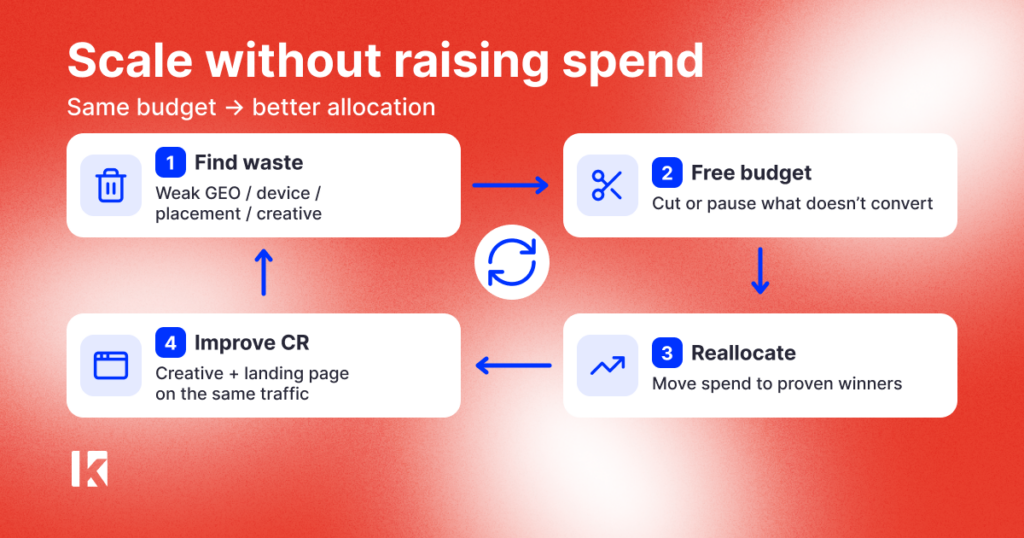
Scaling without additional spend means improving the results generated by the existing budget. For example, one campaign may generate a large number of clicks that rarely convert. Another campaign may have a similar cost level but produce stronger conversion results. Reallocating the budget from the first campaign to the second can increase conversions without changing total spend.
The same principle applies to landing pages. If an advertiser purchases 10,000 visits and improves the conversion rate from that existing traffic, the campaign can scale without buying additional visits. This type of growth usually comes from greater efficiency rather than simply increasing volume.
Audit Current Paid Traffic Campaign Performance
Before making changes, advertisers need to understand current performance. A proper audit should cover traffic sources, targeting settings, ad formats, spend, conversions and audience quality. The objective is to identify two areas:
- Where budget is being wasted;
- Where existing performance suggests that the same budget could be used more effectively.
Relevant metrics include CTR, conversion rate, CPA, CPC and ROI or ROAS where reliable revenue data are available. Performance should not be judged on the basis of a single unusual day. Campaigns need enough data to distinguish genuine patterns from short-term fluctuations.
Identify Underperforming Traffic Sources
Not all traffic sources perform in the same way. One placement may generate inexpensive clicks but almost no conversions. Another may have a higher CPC yet produce much stronger post-click results. Cost alone is therefore not enough. A useful comparison may include:
| Segment | What to Review |
| Traffic source | Conversion quality and total spend |
| GEO | CPA, CR and revenue where available |
| Device | Mobile versus desktop performance |
| Browser/OS | Differences in conversion behavior |
| Placement | Cost relative to target actions |
| Creative | CTR and downstream conversion impact |
If a segment consistently spends budget without producing meaningful outcomes, reducing or excluding it can free funds for stronger areas.
Find Opportunities to Reduce Wasted Ad Spend
Wasted spend can be hidden inside broad targeting. Some campaigns may purchase traffic from GEOs that rarely convert. Others may attract device traffic that does not perform well with the landing page. Certain placements may generate clicks but very little meaningful post-click activity.
Reducing weak segments does not automatically improve results by itself. However, it can release the budget. That budget can then be reallocated towards higher-quality sources that have shown stronger conversion performance.
In Kadam, advertisers can adjust targeting by GEO, device, operating system, browser, language, and placement. This allows optimization at segment level.
Optimize Targeting to Get More From Existing Traffic Spend
Targeting determines which users see an ad. If campaign settings are too broad, budget may continue flowing towards users who are unlikely to complete the target action. The next step is therefore to refine targeting according to actual performance. Advertisers may adjust or reorganize targeting by:
- GEO;
- device;
- operating system;
- browser;
- language;
- placement;
- traffic source.
The objective is not to restrict reach as much as possible. Overly narrow targeting can reduce the available audience unnecessarily. The aim is to identify where relevance and efficiency align.
Focus on High-Performing GEOs and Devices
One country may perform strongly while another produces weaker results. This can happen even when the same offer is being promoted. Device performance may also differ. A GEO with predominantly mobile traffic may generate substantial session volume but a weaker conversion rate.
That difference may be linked to how the landing page performs on smartphones. Another market may convert more effectively only on particular operating systems or browser combinations.
Advertisers should compare both cost and outcomes at segment level rather than relying entirely on overall averages. Kadam reporting allows advertisers to group results by country, browser, OS, device and other dimensions. This can make performance differences between segments easier to identify.
Refine Audience Segmentation
Segmentation can extend beyond technical targeting. Where suitable tracking data are available, advertisers can separate:
- new users;
- previous visitors;
- users who clicked or interacted with the offer;
- converted users;
- retargeting audiences.
Different groups may require different messages. A returning visitor already has some familiarity with the offer. A completely new user does not have the same context. Using identical creative for both groups may be convenient, but it may not be the most efficient approach.
Improve Ad Creatives Without Increasing Costs
Scaling does not always require producing more ads. Often, it involves identifying which existing creatives perform well and replacing those that consistently underperform. Strong creatives can improve CTR. However, generating more clicks should not be the only objective. The creative should attract users who are more likely to complete the target action.
Test Different Headlines, Visuals, and CTAs
Creative testing should follow a structured process. Advertisers can compare:
- headlines;
- main images;
- ad copy;
- value propositions;
- CTA wording.
Where possible, one main element should be changed at a time. If the headline, image and CTA all change simultaneously, it becomes more difficult to determine what caused the performance difference.
Tests also need sufficient traffic to produce meaningful results. A creative that generates three conversions from a very small sample is not automatically stronger than another version that performs consistently across a larger audience.
Refresh Creatives to Prevent Ad Fatigue
Even a strong creative can lose effectiveness over time. When the same audience repeatedly sees the same visual and message, engagement may decline. Advertisers should monitor trends before performance deteriorates significantly.
Falling CTR, weaker conversion rate, and rising CPA can indicate a creative issue, although other factors may also contribute. Where frequency controls are available, they can help reduce excessive exposure.
Optimize Landing Pages to Increase Conversion Rates
Generating clicks is only part of the process. The landing page needs to turn those visits into target actions. If a campaign directs users to a page that is slow, confusing or poorly aligned with the ad, scaling that traffic simply creates more wasted sessions. Important landing-page factors include:
- loading speed;
- mobile compatibility;
- a clear value proposition;
- readable layout;
- simple navigation;
- concise and practical forms;
- a visible CTA;
- consistency between the ad and the page.
The message should remain consistent after the click. If the ad creates one expectation while the landing page presents something different, users may leave even when targeting is accurate.
Improve the Mobile User Experience
Mobile traffic requires dedicated testing. A website may perform well on desktop and still provide a poor experience on a smartphone. Advertisers should confirm that:
- text is readable without zooming;
- forms are easy to complete;
- buttons are large enough to use comfortably;
- the main CTA is visible;
- pop-ups do not block important content;
- the page loads quickly.
Technical issues and slow loading can reduce conversions even when the audience is relevant. That also wastes the budget.
Run Landing Page A/B Tests
Landing-page testing can focus on individual elements such as:
- headline wording;
- CTA placement;
- form length;
- page layout;
- supporting content.
The same principle applies as with creative testing: one variable should be changed at a time where possible. Advertisers should review both conversion rate and conversion quality. A shorter form may produce more leads, but those leads may not be as valuable. The preferred version should improve the business outcome rather than simply perform better on a superficial metric.
Reallocate the Existing Budget to Better-Performing Campaigns
Fixed-budget growth depends heavily on reallocation. If one campaign consistently underperforms while another converts more efficiently, part of the budget can be moved. Total spend remains unchanged.
Changes should be made gradually. Large adjustments can make performance more difficult to interpret and may alter traffic patterns before sufficient new data are available. Advertisers can reallocate budget between:
- campaigns;
- GEOs;
- traffic sources;
- devices;
- formats;
- creatives;
- audience segments.
The objective is not to follow whichever metric appeared strongest yesterday. It is to direct the budget towards consistently better-performing areas.
Choose the Right Ad Formats for Campaign Goals
Different ad formats can produce different traffic patterns. Kadam supports push, in-page push, popunder, banner, native and video.
Push is suitable for concise, direct messaging. Native can work where the offer benefits from a more content-oriented presentation. Popunder can generate reach through a different interaction model. Banner provides visual presence, while Video offers more space to explain a product or value proposition.
Format selection should follow campaign objectives. Options should be compared by cost, conversion quality, and post-click behavior rather than click volume alone.
Use Retargeting to Recover Lost Conversion Opportunities
Some traffic has already been paid for. A user may visit the landing page, review the offer and leave without converting. Retargeting creates an opportunity to re-engage that user. Kadam supports retargeting audiences built from previous campaign data or remarketing code.
Kadam supports cookie-based and fingerprint-based retargeting methods. Retargeting generally works better when audiences are divided into relevant groups. A user who only viewed a page should not necessarily receive the same message as someone who progressed further through the funnel. Creative should reflect previous intent. Frequency also matters. More exposure does not automatically produce better results.
Track the Metrics That Matter for Campaign Scaling
Scaling should be evaluated according to business outcomes rather than traffic growth alone. Useful metrics include:
| Metric | What It Shows |
| Impressions | Ad exposure |
| Clicks | Traffic volume |
| CTR | Response to the creative |
| CPC | Cost per click |
| Conversion rate | Share of users completing the target action |
| CPA | Cost of acquiring a conversion |
| ROI/ROAS | Commercial return where revenue data are available |
CTR is useful, but it is not the only target. A campaign may produce a higher CTR while conversion quality declines. Advertisers should compare performance before and after optimization. They should also assess whether the same budget is now generating more valuable outcomes.
Common Mistakes When Scaling Paid Traffic on a Fixed Budget
One major mistake is acting too quickly. A weak segment may simply require more data. A strong segment may be experiencing a temporary increase. Other common issues include:
- cutting promising traffic after a brief decline;
- shifting too much budget at once;
- prioritizing click volume over conversion quality;
- ignoring landing-page performance;
- keeping the same creative active for too long;
- failing to segment reporting by GEO, device or source;
- scaling before conversion tracking is reliable;
- assuming that cheap traffic is automatically high-quality traffic.
Random changes create additional noise. Structured optimization creates a clearer evidence base.
How Kadam Helps Advertisers Improve Paid Traffic Campaigns
Kadam provides tools for launching, analyzing and adjusting paid traffic campaigns across several ad formats.
The platform processes more than 11 billion impressions per day and supports popunder, push, in-page push, banner, native and video. Advertisers can structure tests using targeting options such as GEO, device, operating system, browser, language and placement.
This makes it possible to compare results across different audiences and traffic conditions. Kadam reporting can break down performance by country, browser, OS, device, ad format and creative. Available metrics include clicks, impressions, CTR, CPC, conversions, CR and spend.
Advertisers can also use site data and macros to understand where traffic originates and then adjust campaign settings accordingly. Kadam supports fields such as site ID, campaign ID, creative ID, click cost, browser, language, OS and device through URL macros.
Retargeting provides an additional layer. It allows advertisers to build audiences from previous visitors or campaign interactions and re-engage users who have already shown interest.
Kadam also supports blacklists and whitelists for controlling specific traffic sources. Traffic volume is influenced by targeting breadth, bids and creative CTR.
Conclusion
Scaling paid traffic without increasing the budget is primarily about efficiency. The first step is to review current performance and identify where the budget is being wasted.
Advertisers can then refine targeting, shift spend towards stronger GEOs and devices, improve creatives, optimize landing pages, and reallocate budget gradually towards better-performing campaigns.
Retargeting can re-engage users who have already shown interest, while testing additional formats may reveal more efficient ways to achieve the same objective.
The overall budget does not necessarily need to increase. However, the way it is allocated may need to change. That is the principle behind fixed-budget scaling: less waste, better traffic decisions, and greater focus on conversions that create meaningful value.
FAQ
Can Paid Traffic Be Scaled Without Increasing the Budget?
Yes, in some cases. Advertisers may increase conversions or improve traffic quality by reducing wasted spend, improving conversion rates and reallocating budget towards stronger segments. The available growth depends on how efficient the current campaigns already are.
How Can Wasted Ad Spend Be Reduced?
Advertisers should compare traffic segments using CPA, conversion quality and available ROI or ROAS data. GEOs, placements, devices, and sources that consistently consume budget without producing useful outcomes can then be reduced or excluded.
How Do Landing Pages Support Paid Traffic Growth?
A stronger landing page can convert more users from the same volume of ad clicks. Faster loading, mobile compatibility, clearer value communication, and a visible CTA can improve results without increasing ad spend.
Which Metrics Should Be Monitored During Paid Campaign Optimization?
CTR, conversion rate, and CPA are key metrics. Where reliable revenue data are available, ROI or ROAS can provide additional business context. Click quality and conversion quality should also be assessed rather than relying only on raw volume.
When Should Advertising Budget Be Reallocated?
The budget should be reallocated after enough data have been collected to identify stable differences between campaigns or segments. Large changes should not be made solely on the basis of a few days of short-term fluctuation.



Read Also

Pops in Affiliate Marketing: Complete Guide to Launch and Optimization

How Popunder Traffic Drives the Growth of the African iGaming Market
Gambling in Tier-2 & Tier-3 GEOs: When to Launch and Which Countries Deliver the Best ROI in 2026

How to Use CPC and CPM Models in Arbitrage in 2025

What Is Popunder Traffic and How Can You Work with It?

How to achieve 65% ROI with Native Ads on Kadam: real case from advertiser

Dating Vertical Playbook 2026: GEO, Landing Pages, and Push/Pop Campaigns

Top 10 iGaming Ad Networks: Comparing the Best Platforms

iGaming Vertical Playbook 2026: Targeting, KPIs, Briefs, and Anti-Fraud
