
Retargeting Campaign Optimization: How to Improve Performance and Reduce Ad Fatigue
Learn how to optimize retargeting campaigns, improve conversions, and reduce ad fatigue with better audience segmentation, creative testing, frequency management, and performance tracking.
22 Oct 2026
Retargeting campaigns do not remain effective without regular optimization. Audience composition changes, creatives lose impact, some users convert while others lose interest, and the same ad frequency that worked at the beginning may become excessive over time.
Better retargeting performance usually comes from several connected actions: segmenting the audience more precisely, refreshing creatives, controlling how often the same user sees an ad, reviewing bids and budgets, and analysing conversion data. The aim is not simply to generate more impressions or clicks. It is to maintain relevance without repeatedly exposing users to the same message.
What Is Retargeting Campaign Optimization?
Retargeting campaign optimization is the process of improving how ads reach users who have already visited a website, landing page, offer or another tracked page or event.
A campaign may begin with one audience, several creatives and a fixed bid. However, those settings should not remain unchanged indefinitely. Over time, advertisers should review factors such as:
- audience size and composition;
- funnel stage;
- creative performance;
- frequency;
- conversion rate;
- CPA;
- available revenue data;
- results by format, GEO and device.
Optimization therefore involves more than changing a bid. A strong retargeting setup continues directing spend towards users who remain relevant while reducing exposure to users who have already converted, stopped engaging or received too many impressions.
Kadam’s retargeting tools, for example, allow advertisers to build audiences, include or exclude specific segments and track post-view and post-click conversions where the required data is available.
What Is Ad Fatigue and Why Does It Happen?
Ad fatigue occurs when users see the same ad too frequently and gradually become less responsive to it. At first, repetition may help users notice and remember the message. After repeated exposure, however, the ad can become background noise.
The decline is not always dramatic. Performance may weaken gradually. CTR may fall. Conversion rate can decline. CPA may rise because the advertiser continues purchasing impressions without receiving the same level of response.
Not every period of weaker performance is caused by fatigue. Seasonality, weaker traffic quality, increased competition, targeting changes and landing-page issues can produce similar patterns. Ad fatigue should therefore be assessed using several metrics together.
Common Signs of Ad Fatigue
Possible warning signs include:
- CTR declining across comparable periods;
- conversion rate falling while traffic remains stable;
- CPA gradually increasing;
- a previously strong creative losing engagement;
- one audience segment weakening faster than others;
- impressions continuing to increase while conversions remain relatively flat.
The broader context still matters. If CTR falls while conversion rate increases, the campaign may simply be attracting fewer but more qualified clicks. A single metric can therefore be misleading.
Before attributing performance changes to fatigue, advertisers should compare similar time periods, audience segments and ad formats.
Factors That Contribute to Ad Fatigue
High frequency is one of the most common causes. When the same user sees the same ad repeatedly within a short period, the message can lose its impact quickly.
Creative variety also matters. If a campaign relies on one headline and one image for too long, users have less new information to notice.
Audience size can influence the effect as well. A small retargeting audience may receive repeated impressions very quickly because the campaign cycles through the same users. A broader audience can reduce this pressure, although it may also make the message less specific.
Poor relevance can make the problem worse. Even a new creative may perform poorly if it no longer reflects what the user did previously or where that user is in the funnel.
How to Segment Audiences for Better Retargeting Performance
Segmentation can reduce one of the most common retargeting mistakes: treating every engaged user as part of the same audience. A visitor who viewed a landing page is not the same as someone who registered. A converted customer represents another segment entirely. Separating these stages more clearly gives advertisers greater control over creative, frequency and budget.
Segment Users by Funnel Stage
A practical retargeting structure may look like this:
| Audience Segment | Previous Action | Retargeting Approach |
| Visitors | Viewed a website or offer | Reintroduce the value proposition |
| Registered users | Registered but did not complete the target action | Encourage the next step |
| Converted users | Completed an earlier conversion | Use only where repeat engagement is relevant |
| Inactive users | Previously active but stopped engaging | Use reactivation-focused messaging |
Each group requires a different approach. Users should also be removed once they complete the original target action if further exposure is unnecessary. Kadam supports separate inclusion and exclusion audience lists for retargeting and allows advertisers to exclude users who have already converted.
Use Behavioral Data to Improve Relevance
Behavioral data can make segmentation more precise. Visited pages, viewed offers and other tracked events can indicate what users previously showed interest in.
For example, a user who spent time on one offer may not need the same retargeting ad as someone who viewed a different category.
The available segmentation depends on the data actually collected and transmitted through the tracking setup. This distinction is important. Retargeting should rely on confirmed signals rather than assumptions about interests that the platform cannot observe.
How to Optimize Retargeting Ad Creatives
Retargeting ads require regular review. Even a strong creative can lose impact when the same audience sees it too often. Optimization often involves controlled testing of:
- Headlines;
- Images;
- CTA wording;
- Value propositions;
- Message length;
- Different creative concepts.
Updating an ad should not be random. The new version should still suit the same audience and reflect its position in the funnel.
Refresh Creatives Before Performance Declines
Advertisers should not wait until performance declines sharply. Once an ad is already performing poorly, it can become more difficult to understand what changed and why. Individual ads should be monitored separately, with alternative versions prepared while the current creative is still performing well.
If CTR and conversion rate begin to decline gradually despite a stable audience, a new creative can be tested before the deterioration becomes more significant. Alternatives should be tested under comparable conditions. A new creative tested in a different GEO or against a substantially different audience does not provide a fair comparison.
Match Ad Creatives to Audience Intent
Creative should reflect what the user has already done. A user who viewed an offer may receive a reminder focused on the same value proposition. A registered user may need messaging related to the next relevant step. An inactive user may respond better to a reactivation message than to a general introduction. The objective should be relevance rather than pressure.
Frequency Capping: How to Prevent Ad Fatigue
Frequency capping limits how many times the same ad is shown to one user within a defined period. It is a practical way to manage ad fatigue. Too little exposure may mean the message is never noticed. Too much exposure can make the campaign repetitive and inefficient.
Kadam supports frequency settings for retargeting campaigns. Caps can be set at campaign level and, for formats that use creatives, at material level. Popunder uses a campaign-level frequency cap.
How to Find the Right Ad Frequency
There is no single ideal frequency for every campaign. The appropriate setting depends on:
- audience size;
- funnel stage;
- campaign duration;
- ad format;
- buying cycle;
- CTR and conversion behavior.
A short-term campaign may tolerate a different exposure pattern from a longer reactivation campaign. Instead of applying one fixed number to every campaign, advertisers should test frequency and compare results. The objective is to achieve enough repeated exposure for the message to be noticed without continuing to spend on users who have stopped responding.
Exclude Converted and Overexposed Users
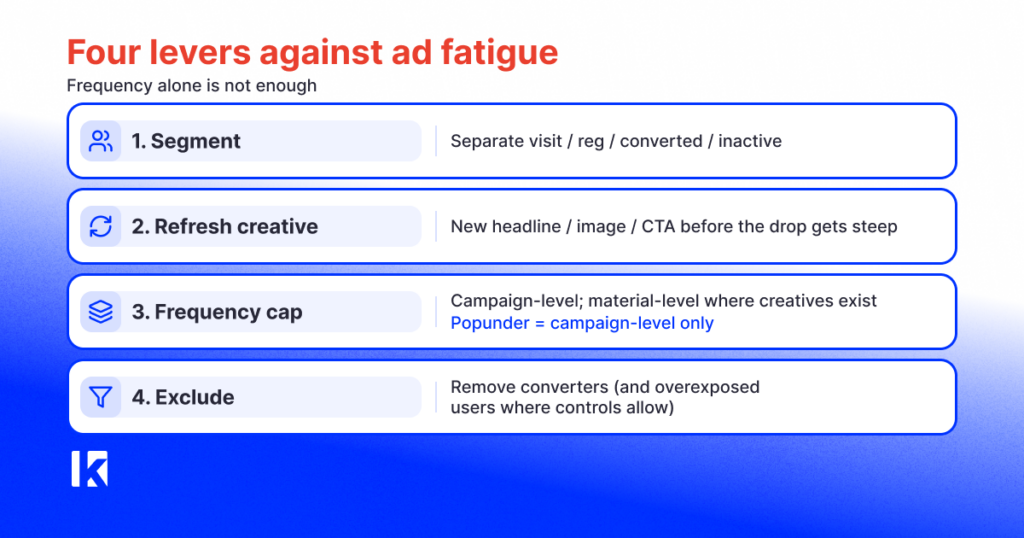
Exclusions can reduce wasted impressions quickly. If a user has already completed the target conversion, that person may no longer belong in the same retargeting audience.
Overexposed users can also be excluded or temporarily removed where campaign rules and available audience controls allow it. This can help protect the budget and reduce unnecessary repeated spend.
How to Optimize Retargeting Bids and Budget Allocation
Budget allocation should reflect actual performance. If one audience segment delivers a lower CPA or stronger conversion rate across a meaningful amount of data, it may justify more budget than a weaker segment.
The same principle applies to ad formats. Push may perform differently from Native. Popunder may produce another type of traffic behavior. Advertisers can compare:
- CPA;
- conversion rate;
- CPC;
- volume;
- ROI or ROAS where revenue data are available.
Short-term fluctuations should not trigger immediate decisions. A small number of conversions can make a limited audience appear unusually strong, while one weak day does not necessarily mean a campaign should be reduced or stopped.
Kadam distributes traffic through an auction model in which bids influence traffic volume. Targeting reach, CTR, and bid levels also affect how much traffic a campaign can get.
How to Choose the Right Ad Formats for Retargeting
Retargeting can use several ad formats. Kadam supports push, in-page push, popunder, banner, native, and video for retargeting. Each format creates a different user experience.
Push provides a concise, direct message. Native can integrate more naturally with publisher content. Banner can provide consistent visual exposure. Popunder opens a new destination after user interaction. Video provides more space to explain an offer.
No single format should be assumed to perform best in every situation. The appropriate choice depends on audience intent, funnel stage, targeting options and campaign objectives.
A/B Testing for Retargeting Campaign Optimization
A/B testing allows advertisers to compare campaign changes under controlled conditions. Possible tests include:
- one headline against another;
- two visual concepts;
- different CTAs;
- alternative frequency settings;
- different audience segmentation approaches;
- two landing-page versions.
Where possible, one main variable should be changed at a time. If the creative, bid, audience, and landing page all change simultaneously, it becomes difficult to determine what caused the performance difference.
Tests should also run long enough to collect sufficient data. If a result is based on only a few conversions, it may reflect random variation rather than a reliable effect.
How to Measure Retargeting Campaign Performance
Retargeting should be assessed using several metrics rather than one.
| Metric | What It Helps Measure |
| Impressions | Exposure volume |
| Frequency | Repeated exposure per user |
| CTR | Response to the ad |
| Conversion rate | Share of traffic completing the target action |
| CPC | Cost per click |
| CPA | Cost per conversion |
| ROI/ROAS | Commercial return where revenue data are available |
CTR alone is not enough. A creative may generate more clicks without increasing conversions. Advertisers should compare results across audiences, creatives, formats and time periods.
Kadam’s reporting tools include filters and breakdowns by ad format, country, browser, OS, device and CTR. These options can help advertisers identify performance differences between segments.
Common Retargeting Optimization Mistakes
Several issues occur repeatedly. One is failing to segment audiences properly. Another is allowing frequency to rise while the same ad continues running for too long. Other common problems include:
- missing conversion tracking;
- failing to exclude users who have already converted;
- scaling before sufficient data are available;
- treating CTR as the only success metric;
- keeping weak ads active because they performed well previously;
- changing several campaign elements at the same time;
- ignoring differences between formats, devices, or GEOs.
A systematic review can help identify where performance is weakening. Optimization tends to be more effective when advertisers can identify exactly what changed and why.
How Kadam Can Help Optimize Retargeting Campaigns
Kadam provides tools that can support a structured retargeting workflow. The platform processes more than 11 billion impressions per day and supports targeting by GEO, device, operating system, browser, language and placement. Retargeting functionality can be used to bring back users who previously interacted with a website or ad but did not complete the main target action.
Supported formats include push, in-page push, popunder, banner, native, and video. This allows advertisers to compare different ad types within the same environment instead of relying on a single format.
Kadam also supports audience exclusions, conversion tracking, and frequency controls for retargeting. Reporting can be used to compare performance by GEO, device, browser and ad format.
Traffic quality is also assessed at source level. Kadam states that its anti-fraud system, Kaminari, is used to identify suspicious activity. The platform also provides support with campaign setup, creatives, reporting and ongoing optimization.
Conclusion
Retargeting optimization is an ongoing process. Campaign performance tends to decline when audiences are poorly segmented, ads remain unchanged for too long or the same users receive too many impressions.
Reducing frequency alone does not completely solve ad fatigue. Advertisers should combine audience segmentation, creative refreshes, appropriate exclusions, controlled exposure and regular performance analysis.
Budget decisions should be based on conversion data rather than short-term fluctuations. Format selection should also reflect campaign objectives and the way users experience the ads.
The central principle is balance. A retargeting campaign needs enough exposure to remain visible while maintaining sufficient relevance and variation to avoid becoming background noise.
FAQ
What Is Retargeting Campaign Optimization?
Retargeting campaign optimization is the ongoing process of improving results by analyzing audiences, testing creatives, controlling ad frequency, adjusting spend and tracking conversions.
What Is Ad Fatigue in Retargeting?
Ad fatigue occurs when users repeatedly see the same ad and gradually become less responsive to it. Declining CTR or conversion performance may indicate fatigue, although other campaign factors should also be reviewed.
How Often Should Retargeting Ads Be Changed?
There is no universal schedule. Creatives should be updated according to performance trends, audience size and the level of repeated exposure rather than according to a fixed calendar interval.
How Can Frequency Capping Improve Retargeting Performance?
Frequency caps limit how often an ad is shown to the same user. This can reduce wasted impressions and lower the risk that excessive repetition weakens ad performance.
Which Metrics Matter Most for Retargeting Optimization?
Key metrics include frequency, CTR, conversion rate and CPA. CPC can provide additional context, while ROI or ROAS can be reviewed when reliable revenue data are available. These indicators should be assessed together rather than individually.



Read Also

Pops in Affiliate Marketing: Complete Guide to Launch and Optimization

How Popunder Traffic Drives the Growth of the African iGaming Market
Gambling in Tier-2 & Tier-3 GEOs: When to Launch and Which Countries Deliver the Best ROI in 2026

How to Use CPC and CPM Models in Arbitrage in 2025

What Is Popunder Traffic and How Can You Work with It?

How to achieve 65% ROI with Native Ads on Kadam: real case from advertiser

Dating Vertical Playbook 2026: GEO, Landing Pages, and Push/Pop Campaigns

Top 10 iGaming Ad Networks: Comparing the Best Platforms
iGaming Vertical Playbook 2026: Targeting, KPIs, Briefs, and Anti-Fraud
