
More Revenue from Existing Traffic: How Kadam Smart Mediation Works
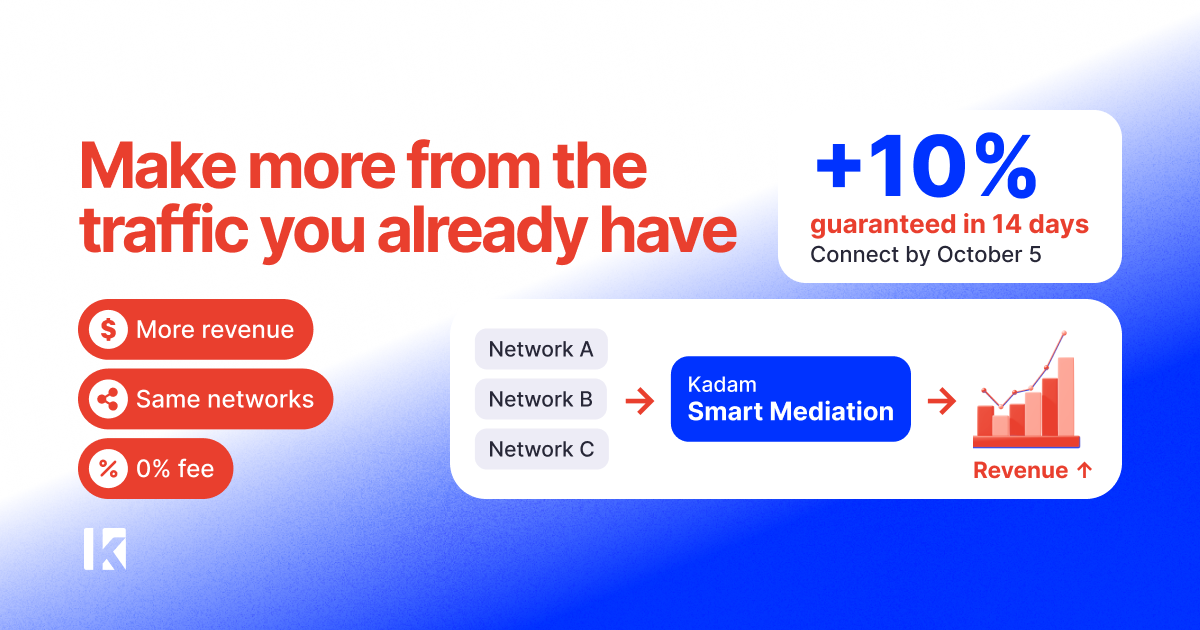
Kadam has launched mediation for publishers. The system compares the actual revenue generated by ad networks, automatically distributes traffic, and adds Kadam demand with no mediation fee.
29 Sep 2026
Publishers now have a new traffic monetization tool — Kadam Smart Mediation. It helps generate more revenue from existing traffic without giving up current ad networks or changing the terms of working with them.
Kadam Mediation compares how much connected sources actually generate, automatically distributes traffic between them, and adds Kadam advertising demand.
The main idea is simple: more revenue from your existing traffic without changing ad networks or paying a mediation fee.
Why a High CPM Does Not Always Mean Higher Revenue
When comparing ad networks, it is easy to focus on the CPM shown in their dashboards. But this figure alone does not always reflect actual revenue.
For example, a network offers a CPM of $2.10 but monetizes only 60% of the traffic sent to it. The remaining 40% may not be monetized at all or may be passed to another source. As a result, the effective revenue from that network is $1.26, even though this may not be visible in its dashboard.
Kadam Smart Mediation takes this difference into account and compares networks based on how much revenue the full volume of traffic sent to them actually generates. This gives publishers a more accurate understanding of which source is truly more profitable.
How Kadam Smart Mediation Works
The publisher connects their ad networks to Kadam via API. The system then starts comparing their actual revenue and distributing traffic between the sources. Several parameters are taken into account:
- country
- operating system
- proxy
- user uniqueness
This makes it possible to compare performance not only at the network level but also across individual traffic segments. For example, one source may monetize users from a particular GEO or device more effectively, while another may perform better for a different segment.
New sources initially receive a test share of traffic so the system can collect enough data. After that, distribution changes automatically based on performance.
If a source starts generating more revenue, its share increases. If its revenue declines, part of the traffic is reallocated to other sources.
Keep Your Existing Ad Networks
You do not need to stop working with your current ad networks to use Kadam Smart Mediation. Publishers continue working with them under the same terms and receiving payments directly.
Mediation acts as an additional optimization layer, helping determine the most profitable way to distribute existing traffic between connected sources. The tool can also be used alongside a publisher’s current mediation solution.
Additional Demand from Kadam
In addition to existing networks, Kadam’s own advertising demand also participates in traffic distribution: Kadam retargeting and direct traffic.
Certain users may be especially valuable to individual advertisers, which means they may be willing to pay more for those impressions.
As a result, Kadam may offer a higher price for a specific segment and receive that traffic in the distribution. The logic remains beneficial for the publisher: Kadam receives traffic only when it can offer more revenue than the other connected sources. If Kadam does not provide the highest return, the traffic continues to be monetized through other networks.
No Mediation Fee
Kadam does not charge a separate fee for using mediation. Existing ad networks continue paying publishers directly.
Kadam earns from its own advertising demand when it receives part of the traffic based on the revenue comparison. In other words, publishers do not pay Kadam to distribute traffic between their networks.
Less Manual Optimization
Ad network performance changes constantly. It can depend on GEO, device, browser, time, audience composition, and advertiser demand. A source that performs best today may be outperformed by another one tomorrow.
Without automation, publishers have to compare reports from different networks manually and adjust traffic distribution themselves. Kadam Mediation does this automatically. The system tracks actual performance and changes traffic allocation as source profitability changes.
One Approach to Comparing Networks
Another challenge when working with multiple ad networks is that their reporting can differ. Networks may define GEO differently, count impressions in different ways, use different time zones, or calculate statistics differently.
Kadam standardizes the data and compares sources based on actual revenue per 1,000 impressions sent. Traffic that a network did not accept or was unable to monetize is also included in the calculation.
This makes it possible to compare all sources using the same principle.
How Revenue Can Change
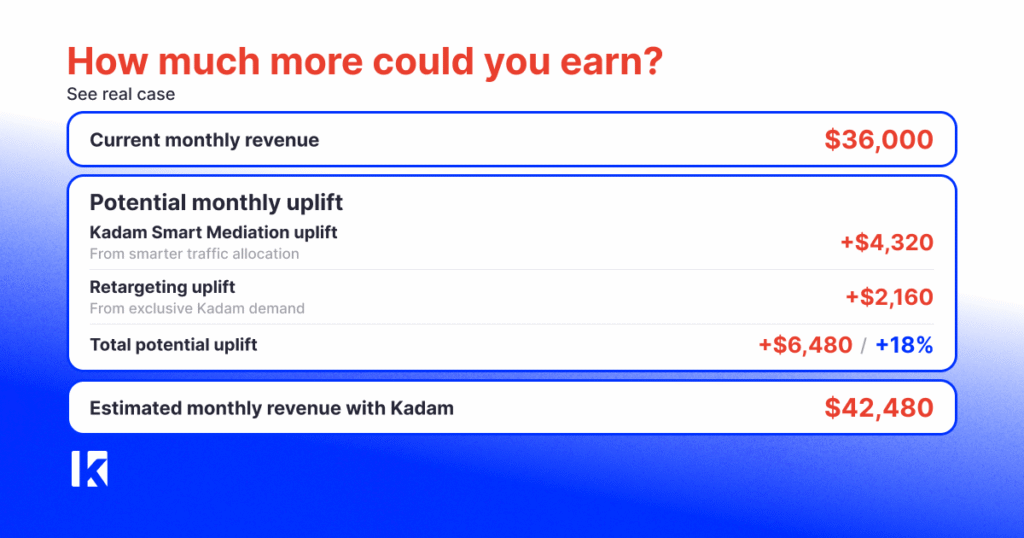
This is a calculated example that demonstrates how mediation works. Actual results depend on the specific traffic, the mix of connected networks, demand, and other parameters of the ad placement.
Start with Just One Website
There is no need for exclusivity or to move all monetization to Kadam. A publisher can start with one website and see how the tool performs on their traffic.
Mediation can be disabled at any time. Existing ad placements and ad network integrations will continue to work.
If one network uses several zones of the same format, they can be connected as separate sources. For example, a popunder on the homepage and a popunder in the player can be analyzed separately if they use different zone IDs.
More Competition for Traffic, More Opportunities for Publishers
Kadam Smart Mediation does not replace a publisher’s existing ad networks. Instead, it makes sources compete for individual traffic segments based on actual performance.
Publishers do not need to choose between Kadam and their current partners. All sources can work simultaneously, while traffic is automatically sent to the source where it generates the most revenue.
For publishers, this means: more demand sources, more accurate traffic distribution, and less manual optimization — with no mediation fee.





Read Also
How Ad Network Platforms Connect Advertisers and Publishers
KAI for Publishers: Get Answers About Statistics and Monetization in Seconds
VAST Video Ads: A New Monetization Format Is Now Available in Kadam
Push Notifications: Easily Migrate Your Subscriber Base and Connect Multiple Providers on One Domain
Popunder CPM for Publishers: What Affects Website Revenue
Frequency Capping: Full Guide to Increase Popunder Revenue
Popunder Ads for Publishers: How Website Owners Earn from Pop Traffic
How to Monetize a Website Without Google AdSense
Popunder Ads for Publishers